Industrial Fried Peanut Processing Line
Complete fried peanut line: blanching, slitting, frying, deoiling, flavoring, packaging.
This site uses cookies for analytics and to improve your experience. By clicking Accept, you consent to our use of cookies. Learn more in our privacy policy.

Complete fried peanut line: blanching, slitting, frying, deoiling, flavoring, packaging.
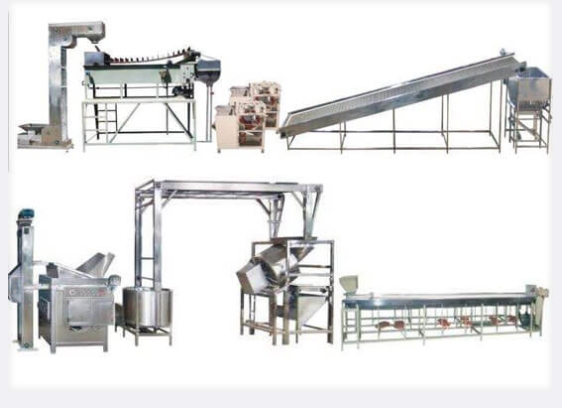
Sample output from the Industrial Fried Peanut Processing Line. Ask us for real production photos matched to your exact product and capacity.
Complete fried peanut line: blanching, slitting, frying, deoiling, flavoring, packaging. 500-2,000 kg/h. Produces fried peanuts, broad beans, mixed snacks.
| Model | Capacity | Configuration |
|---|---|---|
| FPL-701 Entry | 500 kg/h | 5-stage line. 15m. 3 operators, 18 kW. |
| FPL-701 Standard | 1,000 kg/h | 7-stage with auto-packaging. 20m. 5 operators. |
| FPL-701 Industrial | 2,000 kg/h | 8-stage with VFFS packaging. 25m. 7 operators. |
Typical values — each model is configured to your product, cut size, and line speed.
Snack producers frying and coating peanuts at line scale — from raw kernel to seasoned, packed product. For the full range, see the processing hub.
Size against finished output per shift rather than raw kernels. The entry configuration processes about 500 kg/h, which works out near 4 tonnes per 8-hour shift, while the industrial configuration doubles that twice to roughly 16 tonnes. You also need floor length: line sizes run from 15 m for the 5-stage version to 25 m for the 8-stage version with packaging. Share your shift plan and we will match the stage count.
Palm, peanut, and canola all work, so choose on local price and the flavor profile you want; peanut oil suits a traditional fried peanut taste. The bigger factor is oil management: with the filtration system fitted, plan a change every 8 hours of frying. Filtering on schedule keeps off-flavors out of the finished snack and protects the deoiling stage downstream.
Greasiness usually points at the deoiling stage or fryer temperature, not the kernels. If the fryer runs below its set band, the crust seals slowly and the kernel absorbs oil; if the deoiler is overloaded or its cycle is cut short, surface oil stays on. Check the thermostat against a probe first, then confirm the deoiling time matches the throughput you are actually running.
The drum flavorer applies 3 to 8% seasoning by weight, adjustable to your recipe. Rate depends on drum speed, residence time, and whether you apply oil first as a tack carrier. For mixed snack runs, the drum is emptied and flushed between flavors. Send us your target flavors and we confirm the changeover procedure and any dosing equipment needed for each.
The entry 5-stage line draws about 18 kW and runs with 3 operators; larger configurations scale to 5 operators at 1,000 kg/h and 7 at 2,000 kg/h with VFFS packaging. You will also need the fryer heat source specified for your configuration, extraction over the fryer, water for blanching, and a drained, washable floor. We issue a full utility schedule per configuration before shipping.
Yes. We provide installation and commissioning support, and 12 months of after-sales service, including spare parts help and technical response.

 7 * 24 Support
 Remote Support
 Global Coverage