Industrial Multifunctional Nut Roaster
The MNR-001 roasts all nut types — peanut, almond, cashew, walnut, pistachio, macadamia — on one machine.
This site uses cookies for analytics and to improve your experience. By clicking Accept, you consent to our use of cookies. Learn more in our privacy policy.

The MNR-001 roasts all nut types — peanut, almond, cashew, walnut, pistachio, macadamia — on one machine.
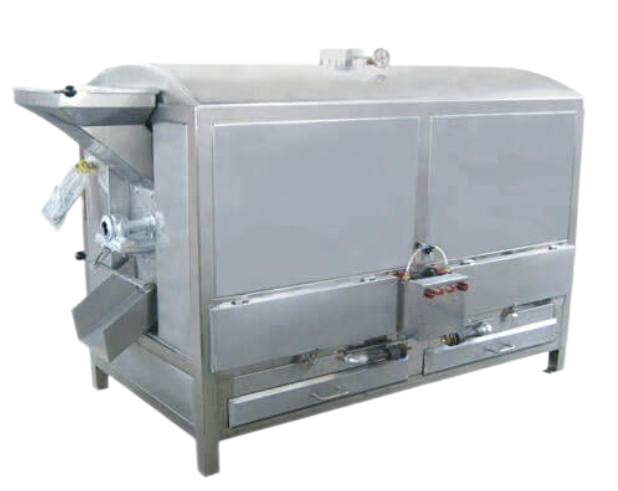
Sample output from the Industrial Multifunctional Nut Roaster. Ask us for real production photos matched to your exact product and capacity.

The MNR-001 roasts all nut types — peanut, almond, cashew, walnut, pistachio, macadamia — on one machine. Multi-fuel (gas/electric/wood). 300-1,500 kg/h.
| Model | Capacity | Configuration |
|---|---|---|
| MNR-101 | 300 kg/h | Multi-fuel. Small nut processors. 1.5 kW. |
| MNR-001 | 800 kg/h | Multi-fuel. Mid-scale. 3.0 kW. Recipe memory. |
| MNR-201 | 1,500 kg/h | Industrial. 5.5 kW. Continuous feed. |
Typical values — each model is configured to your product, cut size, and line speed.
Nut processors roasting peanut, almond, cashew, and sesame on one machine across seasons. For the full range, see the processing hub.
Each nut gets its own stored program: 10 programmable recipes hold temperature and time per product, so switching from peanut to cashew is a recipe recall, not a re-engineering session. The drum’s lifting flights give uniform exposure regardless of nut, holding roasting variability under 5%. Operators select the recipe, and the machine repeats the exact result from last season.
Natural gas, LPG, electric, and wood or charcoal are all available, but the choice is fixed at order because the burner package differs. Gas and LPG typically win on running cost; electric suits plants without combustion permits; wood and charcoal matter where biomass is cheap or the fuel adds to the product story. Tell us your fuel costs and availability and we size accordingly.
Yes, sesame, sunflower, and pumpkin seeds all run on the same drum, which suits processors whose product calendar moves between nuts and seeds across the year. Seed work wants lower temperatures than nuts, another case for the recipe memory: store a seed recipe once and recall it each season without re-deriving the profile from scratch.
Nuts leaving the drum keep cooking in the bin from their own retained heat, darkening past target and sometimes developing off notes, and residual heat also drives oil migration that shortens shelf life. An external cooling conveyor is recommended to stop the roast the moment it leaves the drum. For nuts especially, where rancidity is the shelf-life enemy, cooling is cheap insurance.
The range runs 300, 800, and 1,500 kg/h. With mixed products, plan on changeovers: emptying the drum, a temperature stabilization period, and a recipe recall, so a mixed day yields less total tonnage than single-product running. We suggest mapping your weekly schedule per product and letting that, not the headline number, choose the drum size.
Yes. We provide installation and commissioning support, and 12 months of after-sales service, including spare parts help and technical response.

 7 * 24 Support
 Remote Support
 Global Coverage