Industrial Flour Purifier
Purifier: removes bran particles from semolina/middlings using air + vibration.
This site uses cookies for analytics and advertising. Accept them all, decline them all, or choose which ones you allow. Learn more in our privacy policy.

Purifier: removes bran particles from semolina/middlings using air + vibration.
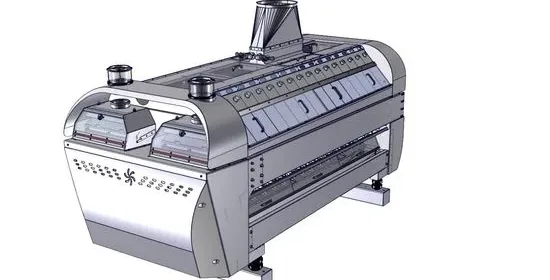
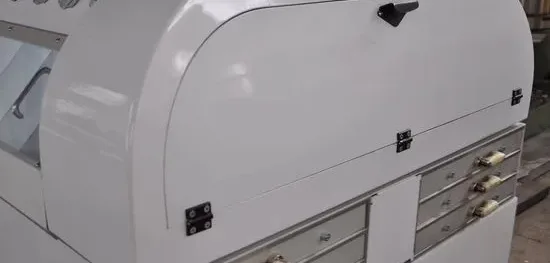
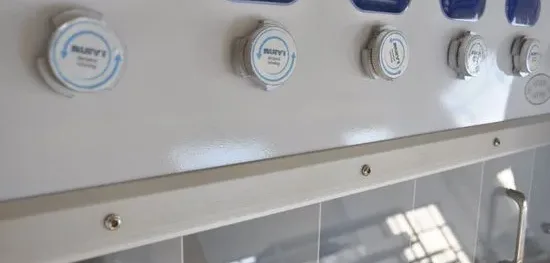
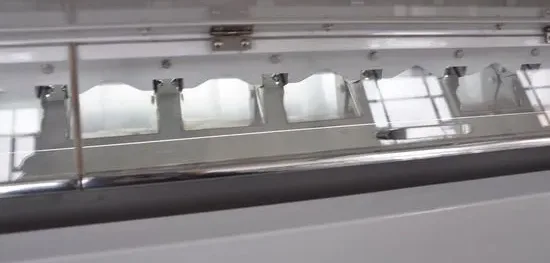
Sample output from the Industrial Flour Purifier. Ask us for real production photos matched to your exact product and capacity.





Flour purifiers refine middlings and semolina between reduction passes — airflow and sieve decks lift bran specks out so flour grades cleanly at 0.6–2.8 t/h.
| Model | Sieve decks | Throughput | Power | Weight | Dimensions |
|---|---|---|---|---|---|
| PRF-101 | 1 | 0.6–2.8 t/h | 2×0.25 kW | 1,216 kg | 2,768×1,334×1,720 mm |
| PRF-001 | 2 | serves 50–150 TPD mills | 2×0.18 kW | 1,500 kg | 2,700×1,300×1,700 mm |
Flour mills cleaning middlings streams between grinding passes. For the full range, see the flour & rice milling hub.
Ash is the mineral residue that tracks bran contamination in semolina, and pasta buyers grade against it. A well-set purifier holds pasta-grade semolina around 0.55 to 0.70 percent ash, which gives the whiter color and cleaner cooking behavior premium pasta demands. Vibration grades the stock while upward air lifts light bran away; that combination is what produces the number.
The machine works on filtered ambient air, typically 2,000 to 8,000 cubic meters per hour depending on model, so plan a clean air source and ducting to match. The air must be filtered, because dust-laden air would re-contaminate the very stock you are purifying. Quarterly filter replacement keeps both the airflow and the separation result stable.
Decks run from one to four, and each deck targets a different particle band. A single-deck unit suits a small mill with one semolina stream, dual-deck mid-scale plants split coarse and fine semolina, and quad-deck industrial setups purify several middlings streams in parallel. The right count follows how many streams your mill sends over, so we map it against your flowsheet.
Yes. Corn grits purification is a supported duty, and the principle is identical: vibration presents the stock to the mesh while air lifts the lighter fraction away, in corn’s case pericarp fragments rather than wheat bran. The settings differ, mainly air volume and mesh cut, so a changeover between grains is a setup adjustment rather than new machinery.
Two levers do the work: air volume and feed rate. More air lifts more light material but risks carrying good semolina over with the bran; less air leaves bran in the product. Watch the split at the discharge and trim from there. Monthly sieve cleaning and quarterly air filter changes keep the calibration honest, because a blinded sieve shifts the balance.
Yes. We provide installation and commissioning support, and 12 months of after-sales service, including spare parts help and technical response.

 7 * 24 Support
 Remote Support
 Global Coverage