Industrial Dough Sheeter
Uniform thin sheets from a continuous belt and multi-stage rollers — croissants, puff pastry, pizza, pie crusts. 200–2,000 kg/h typical.
This site uses cookies for analytics and to improve your experience. By clicking Accept, you consent to our use of cookies. Learn more in our privacy policy.

Uniform thin sheets from a continuous belt and multi-stage rollers — croissants, puff pastry, pizza, pie crusts. 200–2,000 kg/h typical.
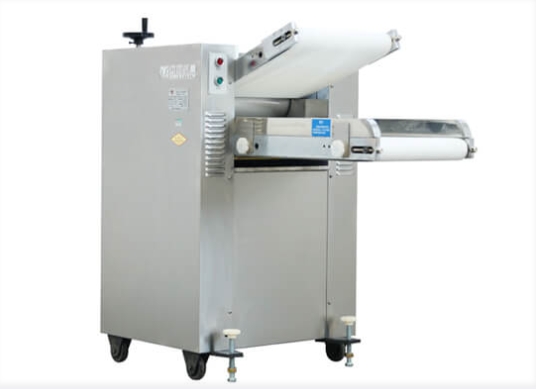
Sample output from the Industrial Dough Sheeter. Ask us for real production photos matched to your exact product and capacity.
The SHT series dough sheeter rolls dough to uniform thin sheets — croissants, puff pastry, pizza, and pie crusts — on a continuous belt through multi-stage rollers. 200–2,000 kg per hour typical, 0.5–30 mm thickness.
Multi-stage rollers reduce thickness step by step instead of forcing it in one pass — sheets leave uniform in thickness and density, which is what laminated pastry and machine-fed pizza lines depend on. Thickness adjusts per pass from 0.5 to 30 mm.
| Model | Belt width | Output | Lamination | Flour duster |
|---|---|---|---|---|
| SHT-101 | 400 mm | 200–600 kg/h | Manual fold | — |
| SHT-001 | 600 mm | 600–1,200 kg/h | Fold and re-sheet | — |
| SHT-201 | 800 mm | 1,200–2,000 kg/h | Fold and re-sheet | Automatic |
Typical values — roller set and belt width configured to your product.
The SHT-001 and SHT-201 fold and re-sheet dough around butter or margarine layers — the multi-layer build behind croissants, Danish, and puff pastry, done by machine instead of by hand at dawn.
The same rollers sheet pizza bases and pie crusts to exact thickness, and flat sheets for pasta products where a flat dough is the starting point.
Sheeted dough feeds forming and cutting lines, then the CVO convection oven or TNO tunnel oven; proofed products come through the PRO proofing chamber. The full range is on the bakery equipment hub.
Take two or three progressive passes instead of one deep cut. Dropping straight from a bulk piece to a thin gauge squeezes the dough sideways, tears the sheet, and stresses the rollers. Reduce thickness in steps, rest the dough between passes if it springs back, and keep a light flour dusting on both sides.
Yes. The sheeter is the core of a lamination program: roll the butter block, enclose it in the dough, then sheet and fold your turns with the dough kept cold between passes. Consistent thickness per pass is what keeps butter layers even, so gauge accuracy matters more than top speed for laminated work.
Belt width follows your widest product plus margin. A bakery sheeting baguette-length strips or full trays of pastry needs a wider belt than one doing individual tart bases. Plan for the widest product you realistically sell, not just today’s menu, because belt width cannot be upgraded later.
Sticking is almost always dough condition rather than machine fault: dough that is too warm or too wet clings to rollers and belt. Bring dough temperature down, adjust hydration in the recipe, and dust evenly. If tearing happens mid-sheet, the dough is overworked or too dry; rest it before the next pass.
A motorized sheeter with one operator running pastry sheets and dough blocks handles far more than hand rolling, with consistent thickness that hand work cannot hold. Realistic hourly figures depend on your product mix and number of folds. We state throughput for your actual products before you order.
Yes. We provide installation and commissioning support, and 12 months of after-sales service, including spare parts help and technical response.

 7 * 24 Support
 Remote Support
 Global Coverage