Industrial Rotary Oven
The whole rack rotates through moving hot air — uniform artisan baking, 100–2,000 kg/h typical, gas or electric, steam injection standard.
This site uses cookies for analytics and to improve your experience. By clicking Accept, you consent to our use of cookies. Learn more in our privacy policy.

The whole rack rotates through moving hot air — uniform artisan baking, 100–2,000 kg/h typical, gas or electric, steam injection standard.
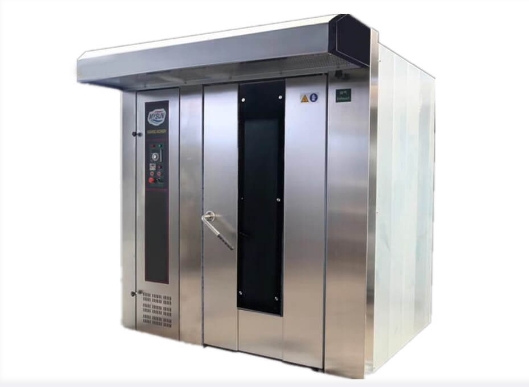
Sample output from the Industrial Rotary Oven. Ask us for real production photos matched to your exact product and capacity.
The RTO series rotary rack oven bakes by rotating the whole rack through moving hot air — every tray the same heat on every side, 100–2,000 kg per hour typical, gas, electric, or diesel. The oven behind artisan bread.
A multi-tier rack rotates inside the chamber while hot air circulates — no hot spots, consistent color and bake from the top tray to the bottom. Standard steam injection puts the glossy crust on artisan loaves that fixed-rack ovens struggle to match.
| Model | Racks | Trays | Output | Typical use |
|---|---|---|---|---|
| RTO-101 | 1 | 16 × 600×800 mm | 100–400 kg/h | Artisan bakeries |
| RTO-001 | 2 | 32 | 400–1,000 kg/h | Bread plants, in-store bakeries |
| RTO-201 | Multiple | 48+ | 1,000–2,000 kg/h | Industrial batch baking |
Typical values — rack count and burner size configured to your product mix.
Gas where it is cheapest to run, electric where the room must stay clean, diesel for remote sites — the same baking chamber on all three.
50–300°C programmable per baking phase — proof-friendly warmth through crust-forming heat, with steam timed to the recipe. Programs store per product, so every shift bakes the same loaf.
Rotary ovens win on batch flexibility and crust quality; continuous plants move to the TNO tunnel oven, cookie and pastry decks to the CVO convection oven. Upstream, the PRO proofing chamber hands over ready dough; the BRS slicer finishes the loaf. The full set is on the bakery equipment hub.
The rack oven bakes one rack at a time and switches products between cycles, so it is the flexible choice for many products, smaller lots, and recipes that need different curves. The tunnel oven runs one continuous bake and wins on cost per kilo at high volume with few products. Below a few thousand pieces per hour across a mixed range, the rack oven is usually the better economics.
The rack rotates through the whole cycle, so every tray passes the same airflow path. Evenness is checked with a bake test: same product on top, middle, and bottom trays, then compared for color and moisture. A healthy rotary oven holds color from top tray to bottom tray within a close band.
Steam at the start of the bake sets the crust: bread and rolls want a strong steam pulse for gloss and volume, pastry wants little or none. The steam generator is sized for full-rack bread loads, and steam quantity and timing are part of each stored recipe program.
Cycle time is bake time plus charge and discharge, so racks per hour follow your recipes. A fast pastry program cycles quickly; heavy bread takes longer per rack. Realistic planning: take your slowest product, add changeover, and that sets the honest hourly figure for a mixed schedule.
Both heat sources work well: gas is typically cheaper to run where supply is reliable, electric is simpler to install and control. Prepare the matching utility (gas line with correct pressure, or a power feed for the heating rating), plus extraction for the oven, and a level floor for the loaded rack weight. We send the exact utility schedule before shipping.
Yes. We provide installation and commissioning support, and 12 months of after-sales service, including spare parts help and technical response.

 7 * 24 Support
 Remote Support
 Global Coverage