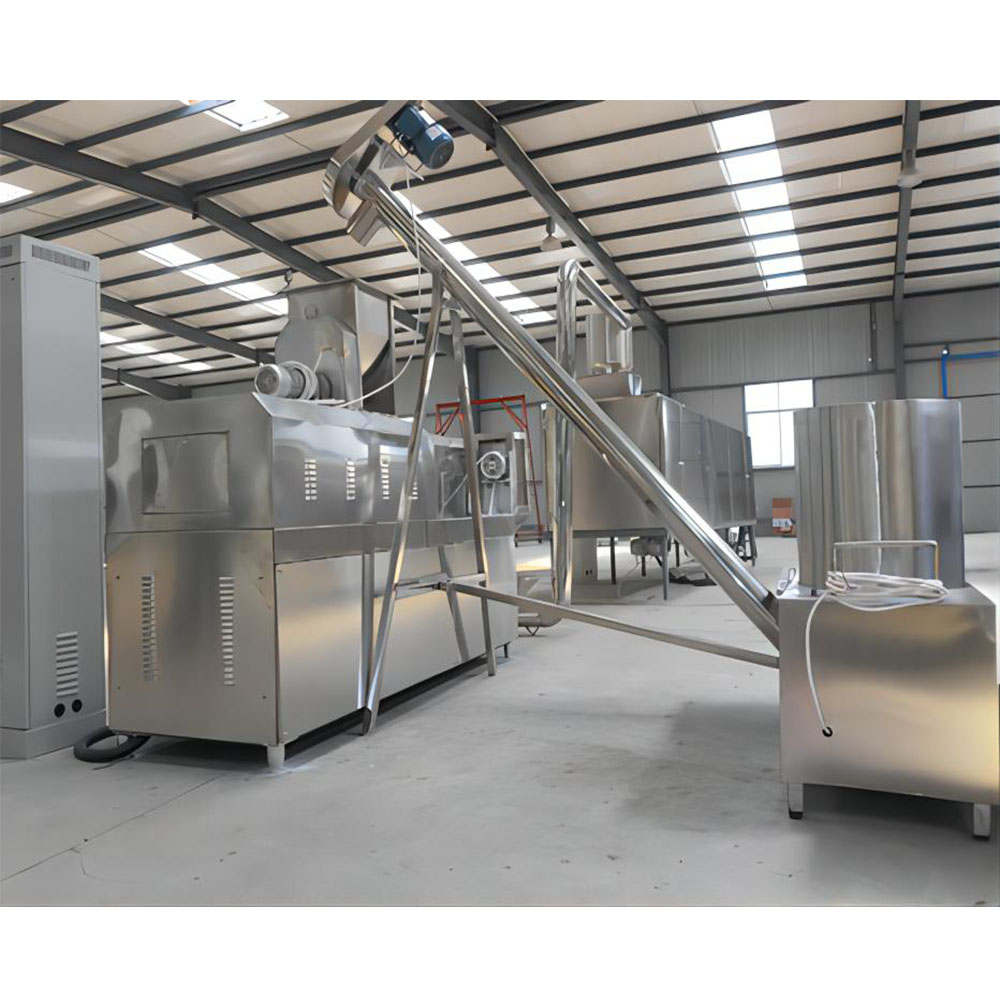
Potato Chips Production Line: Full Equipment List with 2026 Prices
A potato chips production line in 2026 is no longer a row of generic fryers and hand-fed slicers — it is an engineered 8-stage system that must hit exact oil-uptake targets (typically 30–35% for plain, 25–28% for kettle-cooked), nitrogen-flush residual oxygen below 2%, and country-specific food-safety approvals from Mexico’s COFEPRIS, Egypt’s EOS, or the Philippines FDA before a single carton clears customs. With 15+ years exporting industrial snack equipment to 80+ countries — including reference potato chip plants in Mexico, Egypt, the Philippines, Nigeria, and Brazil *(verify specific customer references against your installed-base data)* — we built this guide to give you the full equipment list, real 2026 FOB China pricing across three capacity tiers, and the commissioning mistakes that most often delay first-shipment revenue.
Key takeaways:
- The global potato chips market is sized at USD 35 billion in 2026, growing roughly 5.2% annually through 2030, with the fastest demand coming from Latin America, Africa, and Southeast Asia *(verify against your preferred market-research source)*
- A complete industrial potato chips production line has 8 stages: washing, peeling, slicing, blanching, frying, deoiling, flavoring, and nitrogen-flush packaging — skipping any stage (especially blanching) is the #1 quality failure we see
- Capacity tiers we build are 50 kg/h (workshop / small business), 300 kg/h (small factory), and 1,000 kg/h (industrial) — total line CAPEX ranges from roughly USD 28,000 for a 50 kg/h pilot to USD 480,000+ for a 1,000 kg/h industrial line *(verify final pricing against your RFQ)*
- Plain, crinkle-cut, and kettle-cooked chips share 6 of 8 stages but diverge at the slicer blade and fryer configuration — buy a line configured for your primary style but verify it can swap to a second style within a shift
- Country compliance is non-trivial: Mexico COFEPRIS registration can take 6–9 months, Egypt EOS standard ES 161 requires Arabic bilingual labeling and a local sponsor, and Philippines FDA requires a License to Operate (LTO) plus Certificate of Product Registration (CPR) before import
- SUS304 stainless is the food-contact baseline; SUS316L is strongly recommended for the fryer tank and any surface in permanent oil contact, especially for lines exporting to Saudi Arabia, the UAE, and the EU
- The single most expensive commissioning mistake is under-sized oil filtration — leading to dark, bitter chips within 4 hours of production and an oil-discard cycle that destroys margin
Why Does Potato Chips Remain the World’s Most Resilient Snack Category?
Potato chips are not a growth story — they are a resilience story. Through every downturn of the last 25 years, including the 2008 financial crisis, the 2020 pandemic, and the 2022–2024 inflation cycle, global potato chip volume has grown or held flat in every major market. The category benefits from three structural forces: low per-kg raw material cost (potatoes are among the cheapest calories a snack factory can buy), long ambient shelf life (6–9 months in nitrogen-flush bags), and impulse-buy positioning at every retail touchpoint from kiosks to hypermarkets.
For a B2B investor in Mexico, Egypt, the Philippines, Nigeria, or Brazil, that resilience translates directly into bankable revenue projections. A 300 kg/h potato chips line running two shifts produces roughly 1.4–1.6 metric tons of finished chips per day — enough to service 800–1,200 retail outlets within a 200 km radius, with a gross margin typically between 38% and 52% depending on oil, flavor, and packaging costs *(verify against your local input costs — potato, oil, and polymer film prices vary significantly by country)*.
The same production platform, with a different slicer blade and a longer fryer, can also produce frozen french fries — which is why many of our customers start with potato chips and expand into frozen french fries within 18 months using a shared washing, peeling, and blanching front-end.
The 8-Stage Potato Chips Production Line Explained
A correctly engineered potato chips production line moves the potato through eight stages in a continuous or semi-continuous flow. Each stage is a separate machine; buying them as a matched set from one supplier (rather than piece-meal from multiple vendors) is what determines whether your first production shift ships sellable product or trays of dark, oily rework.
#### Stage 1-2: Washing & Peeling
Raw potatoes arrive with soil, sand, and sometimes agricultural chemical residue. A potato washing and peeling machine uses either abrasive carrot-roll peeling (mechanical friction against silicon-carbide-coated rollers) or brush washing with high-pressure water jets. For industrial lines, we recommend a combined brush washer + abrasive peeler in series — the brush stage removes sand and loose soil that would otherwise dull the peeler’s abrasive drum within weeks.
The peeling loss rate (the % of potato weight removed as peel) is a critical KPI: a well-tuned abrasive peeler runs at 4–6% peeling loss; a poorly tuned one runs at 10–15%, which on a 1,000 kg/h line wastes roughly USD 200–300 of raw potato per shift. Steam peeling is an alternative for very large industrial lines (5+ ton/h) but is rarely justified below 1,000 kg/h.
#### Stage 3: Slicing — Plain, Crinkle, and Kettle-Cut
The potato slicer machine (also called a potato chip cutting machine) is the stage where product identity is decided. Three blade configurations cover the global market:
- Plain flat blade — produces the classic flat-cut chip at 1.2–1.8 mm thickness. This is the default for 80% of industrial lines worldwide.
- Crinkle-cut blade — a ridged stainless blade that produces the wavy chip sold under brands like Ruffles. The ridges hold more seasoning and stand up to heavier dips.
- Kettle-cut blade — a thicker (1.8–2.5 mm) blade, usually combined with a slower, lower-temperature fryer, to produce the artisanal “kettle-cooked” chip with harder bite and irregular shape.
A single potato slicer machine can usually accept two or three blade cartridges that swap in under 15 minutes, but the fryer downstream cannot always be re-tuned as easily — see the Plain vs Crinkle vs Kettle section below.
#### Stage 4: Blanching
Blanching — the brief immersion of sliced potatoes in 70–85°C hot water — is the stage most often skipped by first-time buyers and the stage most often blamed for product failure. Blanching does three things that cannot be undone later in the line: it leaches reducing sugars (preventing dark, bitter chips after frying), it inactivates polyphenol oxidase (preventing grey discoloration on the slice surface before frying), and it gelatinizes surface starch (creating the crisp skin that defines a quality chip).
A line without a blancher will produce chips that look fine for the first hour, then progressively darken as the fryer oil absorbs potato sugars. We consider the blancher non-optional on every line 100 kg/h and above.
#### Stage 5-6: Frying & Deoiling
The continuous fryer is the heart of the line and typically 35–45% of total CAPEX. Industrial potato chip fryers are heated by electric elements, gas burners, or thermal-oil heat exchangers; gas and thermal-oil dominate above 300 kg/h because electric heating at that scale becomes energy-cost-prohibitive in most emerging-market power grids.
Critical fryer specifications include: working oil capacity (typically 1.5–3x the per-hour throughput), temperature control precision (±2°C across the fryer bed), and — most importantly — the continuous oil filtration system that removes fine starch particles every 5–15 minutes. Without active filtration, fryer oil degrades within one production shift.
The deoiling machine (sometimes integrated into the fryer discharge conveyor, sometimes a separate centrifugal deoiler) removes surface oil from the freshly fried chip. Modern centrifugal deoilers can bring finished-chip oil content down from 38–42% (raw fried) to 28–32% — directly improving shelf life, mouthfeel, and the health-claim positioning that increasingly drives retail shelf allocation.
#### Stage 7: Flavoring Drum
The flavoring drum (also called a seasoning drum or coating drum) is an 8-sided or 12-sided rotating stainless drum where flavored powder — barbecue, cheese, sour cream & onion, paprika, chicken, ketchup — is applied to the hot chips. Flavor adhesion depends on three variables: chip surface temperature (55–70°C is optimal — too hot and the powder burns, too cold and it does not adhere), powder particle size (60–100 microns), and a light spray of atomized edible oil applied microseconds before the powder.
A correctly sized flavoring drum achieves 4–6% flavor pickup (4–6 grams of seasoning per 100 grams of chips). An under-sized or under-tuned drum achieves 1–2%, which is the difference between a “cheese” chip and a “chip with the idea of cheese.”
#### Stage 8: Nitrogen-Flush Packaging
The nitrogen-flush packaging machine — typically a vertical form-fill-seal (VFFS) unit with a nitrogen gas flush — is the stage that determines shelf life. Potato chips oxidize rapidly in air; residual oxygen in the sealed bag must be below 2% (industry best practice) or below 1% (premium brand standard). Without nitrogen flushing, shelf life collapses from 6–9 months to 4–8 weeks, which disqualifies the product from modern retail distribution in every target market in this guide.
A correctly engineered packaging machine includes: a multi-headed electronic weigher (10-head or 14-head for production lines above 200 kg/h), a film-unwind system compatible with metalized PET/PE barrier film, a nitrogen generator (PSA type, 95–99% purity) sized to the line, and a date-code printer.
Full Equipment List — 2026 FOB China Prices by Stage
The table below lists the eight machines that make up a complete potato chips production line, with indicative 2026 FOB China pricing in USD at three capacity tiers. These are reference prices for SUS304-stainless, CE-certified, factory-direct machines from a Chinese supplier with 15+ years of export experience; final pricing depends on options (gas vs electric heat, SUS316L upgrade, branded PLC, nitrogen generator included), packaging film type, and freight terms *(verify final pricing against your RFQ — pricing moves with steel, copper, and semiconductor markets)*.
| # | Stage | Machine | 50 kg/h Workshop | 300 kg/h Small Factory | 1,000 kg/h Industrial |
|---|---|---|---|---|---|
| 1 | Washing | Potato washing machine (brush + spray) | USD 1,200 | USD 3,800 | USD 9,500 |
| 2 | Peeling | Potato peeling machine (abrasive roller) | USD 1,400 | USD 4,200 | USD 11,000 |
| 3 | Slicing | Potato slicer machine (interchangeable blade) | USD 1,800 | USD 5,500 | USD 14,500 |
| 4 | Blanching | Continuous blancher (hot-water immersion) | USD 2,200 | USD 6,800 | USD 18,500 |
| 5 | Frying | Continuous fryer (gas or thermal-oil heated) | USD 9,500 | USD 32,000 | USD 95,000 |
| 6 | Deoiling | Centrifugal deoiler (vibrating or rotating) | USD 2,800 | USD 8,500 | USD 22,000 |
| 7 | Flavoring | Flavoring drum (8-sided, SUS304) | USD 2,200 | USD 6,500 | USD 17,500 |
| 8 | Packaging | VFFS nitrogen-flush packager + 10-head weigher | USD 6,800 | USD 22,000 | USD 68,000 |
| — | Conveyors | Bucket + belt + vibrating feeders (set) | USD 1,500 | USD 5,200 | USD 14,500 |
| — | Nitrogen | PSA nitrogen generator (95–99% purity) | USD 2,800 | USD 7,500 | USD 18,000 |
| — | Total line (FOB China, USD) | USD 32,200 | USD 102,000 | USD 288,500 |
*Notes: Pricing excludes sea freight, marine insurance, import duty, local installation, and civil works. Add roughly 12–18% for sea freight + insurance to a typical Latin American, African, or Southeast Asian port. SUS316L upgrade on fryer + flavoring drum adds approximately 8–12% to total line cost. Optional IQF tunnel for dual-mode french-fries production adds USD 35,000–USD 95,000 depending on capacity.*
Potato Chips Line Cost by Capacity — 50 / 300 / 1,000 kg/h
The three capacity tiers below correspond to the three business models our customers most often operate: a 50 kg/h workshop typically serves a single city or a supermarket private-label contract; a 300 kg/h small factory serves a multi-city region or a QSR (quick-service restaurant) supply contract; and a 1,000 kg/h industrial line serves national distribution or a contract-manufacturing export relationship.
| Capacity Tier | Finished Output / Day (2 shifts) | Recommended Business Model | Typical CAPEX (FOB China) | Plant Footprint | Operators / Shift | Payback Period *(illustrative)* |
|---|---|---|---|---|---|---|
| 50 kg/h Workshop | ~160–200 kg finished chips | Small potato chips business; supermarket private label; single-city distributor | USD 28,000 – USD 38,000 | 60–80 m² | 3–4 | 8–14 months *(verify against local potato + oil + film cost)* |
| 300 kg/h Small Factory | ~1,000–1,200 kg finished chips | Regional brand; QSR supply; two-city retail chain | USD 95,000 – USD 130,000 | 250–350 m² | 6–8 | 14–24 months *(verify against local retail shelf price)* |
| 1,000 kg/h Industrial | ~3,200–3,800 kg finished chips | National brand; export contract manufacturing; institutional supply | USD 270,000 – USD 480,000 | 800–1,200 m² | 12–16 | 24–36 months *(verify against capacity utilization — industrial lines need 65%+ utilization to hit payback)* |
ROI illustration — Mexico 300 kg/h line. A 300 kg/h line installed near Mexico City or Monterrey, running two shifts at 75% utilization, produces roughly 1,300 kg of finished chips per day. At a wholesale price of MXN 95/kg (approximately USD 5.50/kg) *(verify against current Mexican wholesale pricing)*, daily revenue is roughly USD 7,150. Against an all-in operating cost (potato, oil, flavor, packaging film, electricity, gas, labor, depreciation) of roughly USD 4,100/day, daily gross profit is approximately USD 3,050 — or roughly USD 915,000/year at 300 operating days. A line that costs USD 130,000 FOB + USD 30,000 installed thus pays back in well under 12 months *(re-verify against actual local potato cost, which is highly seasonal in Mexico)*.
ROI illustration — Egypt 1,000 kg/h line. A 1,000 kg/h line installed near Cairo or Alexandria, running two shifts at 70% utilization, produces roughly 3,500 kg of finished chips per day. At a wholesale price of EGP 110/kg (approximately USD 3.50/kg at recent rates) *(verify against current Egyptian wholesale pricing and FX)*, daily revenue is roughly USD 12,250. Against an operating cost of roughly USD 7,800/day, daily gross profit is approximately USD 4,450 — or roughly USD 1.34 million/year. A fully installed industrial line at roughly USD 480,000 pays back in approximately 18–24 months *(re-verify against Egypt’s potato procurement costs, energy subsidies, and current FX)*.
ROI illustration — Philippines 50 kg/h line. A 50 kg/h workshop line installed near Manila or Cebu, running a single shift at 80% utilization, produces roughly 150 kg of finished chips per day. At a wholesale price of PHP 220/kg (approximately USD 3.90/kg) *(verify against current Philippine wholesale pricing)*, daily revenue is roughly USD 585. Against an operating cost of roughly USD 380/day, daily gross profit is approximately USD 205 — or roughly USD 5,800/month. A workshop line at roughly USD 35,000 installed pays back in 18–24 months *(verify against local supermarket listing fees, which can be material in the Philippines)*.
Plain vs. Crinkle Cut vs Kettle-Cooked — Which Line to Buy: Which Is Better?
Most buyers come to us knowing they want “potato chips” but undecided between the three product styles that dominate the global market. The three styles share 6 of 8 line stages but diverge meaningfully at the slicer, fryer, and deoiler. Buying the wrong configuration is a USD 15,000–USD 60,000 mistake that usually requires either a second fryer or a forced product repositioning within 12 months.
| Attribute | Plain Cut | Crinkle Cut | Kettle-Cooked |
|---|---|---|---|
| Slice thickness | 1.2–1.5 mm | 1.5–2.0 mm (ridged) | 1.8–2.5 mm |
| Fryer temperature | 175–185°C | 175–185°C | 160–170°C (slower) |
| Fryer residence time | 2.5–3.5 minutes | 3.0–4.0 minutes | 8–12 minutes |
| Oil uptake (finished) | 30–34% | 32–36% | 25–28% (lower) |
| Production rate (vs plain) | 100% baseline | ~85% | ~45% (much slower) |
| Equipment delta vs plain | Baseline | +5% (blade + guide rollers) | +25–35% (specialty fryer + batch kettle mode) |
| Retail price positioning | Mass-market | Premium mass / kids snack | Super-premium / artisanal |
| Best for | High-volume distributor brands, QSR supply | Kids’ segment, dip-friendly snacks | Premium retailer brands, gourmet export |
Practical guidance. If you are uncertain, start with plain cut — the configuration has the largest addressable market, the fastest production rate, and the lowest equipment cost. Adding crinkle-cut capability later is a USD 2,000–USD 5,000 blade-and-guide retrofit on most modern slicers. Adding kettle-cooked capability later is significantly more expensive (USD 25,000–USD 60,000) because it typically requires a second, dedicated fryer.
For investors targeting the frozen french fries line market segment as a secondary business, the same washing, peeling, and blanching front-end can serve both lines — but the slicer, fryer, and post-fry handling diverge sharply. We recommend a clear primary-product decision before committing to layout.
Country-Specific Compliance for Potato Chips Imports
Industrial potato chips equipment is, in food-safety terms, only as good as the country approvals behind it. Below are the four compliance regimes most relevant to the buyers in this guide’s target markets.
#### Mexico (COFEPRIS + NOM)
Mexico’s Comisión Federal para la Protección contra Riesgos Sanitarios (COFEPRIS) regulates both the import of food processing equipment and the finished snack product. Equipment imports typically require: COFEPRIS sanitary registration of the importing company, a Certificate of Free Sale from the country of origin (China — issued by China’s CCIB or a comparable body), and compliance with NOM-051-SCFI/SSA1 bilingual labeling on the finished product. Equipment with welded stainless food-contact surfaces must meet NOM-027-SSA1 hygienic design standards. Plan for a 6–9 month COFEPRIS registration cycle *(verify against your local customs broker’s recent experience — COFEPRIS timelines vary by sector)*.
#### Egypt (EOS + NIFA)
Egypt’s Egyptian Organization for Standardization and Quality (EOS) governs compliance with Egyptian Standard ES 161 for snack foods and ES 155 for food hygiene. Packaged chips require Arabic-language labeling, a local Egyptian sponsor or distributor of record, and a phytosanitary certificate for any agricultural input documentation. Industrial equipment must comply with EOS-aligned electrical and hygiene standards; we recommend shipping with CE + ISO 22000 documentation in hand to streamline EOS review. Recent Egypt import policy also requires advance registration through the Nafeza single-window system and an ACID (Advance Cargo Information) pre-shipment declaration *(verify against current Egyptian Customs Authority guidance — this regime updates frequently)*.
#### Philippines (FDA + BFAD)
The Philippines Food and Drug Administration (FDA) — formerly BFAD — requires every imported food manufacturer’s equipment to support a License to Operate (LTO) application by the Philippine importer, plus a Certificate of Product Registration (CPR) for each finished SKU. Equipment documentation typically required: CE certificate, ISO 9001 manufacturer certificate, material test reports for food-contact stainless, and an HACCP flow diagram. Lead time from PO to FDA-cleared finished product is typically 5–8 months *(verify against current FDA Philippines processing timelines — backlog has been variable post-pandemic)*.
#### Brazil (ANVISA) & South Africa (SABS)
For the Latin American and African secondary markets: Brazil’s ANVISA requires equipment to support a Company Operating Authorization and finished-product registration under RDC 27/2010. South Africa’s SABS regulates under SANS 529 (food hygiene management) and SANS 1841 (snack food product specifications). Both regulators accept CE + ISO 22000 documentation but require local-language (Portuguese / English) technical files.
Compliance comparison at a glance:
| Regime | Equipment Approval | Product Registration | Typical Cycle | Local Sponsor Required |
|---|---|---|---|---|
| Mexico COFEPRIS + NOM-051 | Sanitary registration | Yes | 6–9 months | Yes (Mexican entity) |
| Egypt EOS + Nafeza ACID | EOS standard alignment + ACID pre-declaration | Yes (ES 161) | 4–6 months | Yes (Egyptian sponsor) |
| Philippines FDA | LTO + CPR | Yes (per SKU) | 5–8 months | Yes (Philippine LTO holder) |
| Brazil ANVISA RDC 27/2010 | Company Operating Auth | Yes | 8–12 months | Yes (Brazilian entity) |
| South Africa SABS SANS 529 | SABS-aligned hygiene | Yes (SANS 1841) | 4–6 months | Yes (South African entity) |
7 Common Commissioning Mistakes That Delay First-Shipment Revenue
Over 15+ years and 80+ countries of potato line commissioning, the same seven mistakes recur. Each one delays first-shipment revenue by 2–8 weeks and costs between USD 5,000 and USD 60,000 in rework.
- Under-sized oil filtration. A continuous fryer sold with a “500 micron stainless mesh filter” instead of a continuous fine-paper or wedge-wire filtration loop will produce dark, bitter chips within 4 hours of every shift. Specify the filtration loop explicitly in the PO.
- Skipping the blancher. First-time buyers often delete the blancher from the PO to save USD 2,200–USD 18,500. The result is rapid darkening of finished chips and customer complaints within 30 days.
- Nitrogen generator sized for packaging only. The PSA nitrogen generator must be sized to cover both the packaging gas flush and any nitrogen-blanketing on the fryer headspace (to slow oil oxidation). Under-sized nitrogen = fast oil degradation + poor shelf life.
- Wrong potato variety for the fryer. Not every potato is a chip potato. Industrial chip lines require high-specific-gravity, low-reducing-sugar varieties (in Latin America typically Atlantic or Friesland; in Egypt Spunta or Hermes; in the Philippines Granola or Atlantic). Sourcing the wrong variety produces dark chips that no oil filtration can save.
- No water-softening on the blancher. Hard water in the blancher deposits calcium carbonate on heat exchangers within weeks, killing blancher efficiency and adding 8–15% to energy cost. Specify a water softener upstream of the blancher.
- Slicer blade sharpening ignored. Dull slicer blades produce torn slices with high surface starch — which clouds the fryer oil within hours. Sharpening or replacing slicer blades weekly is non-optional above 200 kg/h.
- Single-shift commissioning only. A line commissioned on a single shift for one week is not commissioned. Industrial lines must run two shifts for 10–14 consecutive days before first commercial shipment to surface PLC, conveyor, and packaging-film edge cases that only emerge under sustained load.
Frequently Asked Questions
1. How much does a complete potato chips production line cost in 2026?
A complete potato chips production line ranges from roughly USD 28,000 for a 50 kg/h workshop line to USD 480,000+ for a 1,000 kg/h industrial line, FOB China, SUS304 stainless, CE-certified. The fryer is typically 35–45% of total CAPEX; the nitrogen-flush packaging machine is typically 20–25%. Add 12–18% for sea freight and insurance, and 8–12% if upgrading the fryer and flavoring drum to SUS316L *(verify final pricing against your RFQ)*.
2. Can I start a small potato chips business with under USD 40,000?
Yes — a 50 kg/h workshop line (USD 28,000–USD 38,000 FOB China) supports a viable small potato chips business serving a single city, a supermarket private-label contract, or a QSR supply relationship. Add working capital for 60–90 days of potato, oil, flavor, and packaging film inventory (typically USD 8,000–USD 20,000 depending on country) plus civil works and utility hookup. Total project budget under USD 60,000 is realistic for most emerging-market settings.
3. How do I choose the right potato chips line capacity for my market?
Size the line to finished-output demand, not raw potato throughput. A 50 kg/h line produces roughly 35–40 kg/h of finished chips (peeling, slicing, frying, and deoiling reduce raw potato weight by 20–35%). Map your retail distribution: 50 kg/h serves ~300–500 retail outlets within a single city; 300 kg/h serves ~800–1,200 outlets across 3–5 cities; 1,000 kg/h serves national distribution across 3,000+ outlets. Buy a line sized to 70% of your projected peak demand — running a line flat-out at 100% capacity shortens equipment life and reduces product quality.
4. Can one production line make potato chips AND frozen french fries?
Partially. The washing, peeling, and blanching stages are shared between potato chips and frozen french fries lines, but the slicer, fryer, and post-fry handling diverge. To produce both products on a single line, you need a swappable blade on the slicer, a dual-mode fryer (or a second dedicated fryer), and a downstream IQF (individual quick-freeze) tunnel for the french fries path. Expect a +USD 35,000–USD 95,000 CAPEX delta versus a chips-only line.
5. What food safety certifications should my equipment carry?
Minimum acceptable certifications: CE (electrical safety), ISO 9001 (manufacturer quality system), and material test reports certifying food-contact stainless as SUS304 or SUS316L per ASTM A240 or EN 10088. For export lines targeting Mexico, Egypt, the Philippines, Brazil, or Saudi Arabia, add ISO 22000 (food safety management) and an HACCP flow diagram specific to your line layout. These documents are what COFEPRIS, EOS, FDA Philippines, ANVISA, and SABS will ask for first.
6. What is the typical lead time from PO to commissioning?
Standard models (50 kg/h and 300 kg/h SUS304 configurations) ship within 30–45 days of PO; industrial 1,000 kg/h lines and any SUS316L-upgraded configuration typically ship within 60–90 days. Add 18–35 days sea freight to most Latin American, African, and Southeast Asian ports, plus 15–30 days for customs clearance and local installation. Total project timeline from PO to first commercial shipment: typically 4–6 months for small lines, 6–9 months for industrial lines.
Next Steps — Get a Potato Chips Line Quote Built for Your Market
If you are evaluating a potato chips production line for Mexico, Egypt, the Philippines, Brazil, South Africa, Nigeria, or any other market in this guide, the fastest path to a binding quote is to send us a structured RFQ with these seven inputs:
- Target market country (drives compliance documentation package)
- Daily finished-output target in kg (drives capacity tier selection)
- Primary chip style — plain, crinkle, or kettle-cooked (drives slicer + fryer config)
- Secondary product interest — frozen french fries, potato sticks, vegetable chips (drives shared front-end decisions)
- Stainless spec — SUS304 standard or SUS316L upgrade (drives food-contact material cost)
- Packaging format — pillow bag, doy-pack, multi-pack, or bulk carton (drives VFFS configuration)
- Project timeline — target PO date and target first-shipment date (drives manufacturing slot and freight planning)
Submit the seven inputs above through our contact page and a potato snack line engineer — not a sales rep — will respond within 24 working hours with a line schematic, a stage-by-stage equipment list with 2026 pricing, and a country-specific compliance checklist. We have built reference potato chips plants in Mexico, Egypt, the Philippines, Nigeria, and Brazil *(verify against your installed-base data)*, and we know what fails first in each market.
Learn more: cooking oil processing applications
Get a quote: [email protected]