Industrial Dough Divider and Rounder
Uniform pieces at ±1 g, rounded into smooth balls — 1,000–12,000 pcs/h typical for bread, rolls, and bun lines.
This site uses cookies for analytics and to improve your experience. By clicking Accept, you consent to our use of cookies. Learn more in our privacy policy.

Uniform pieces at ±1 g, rounded into smooth balls — 1,000–12,000 pcs/h typical for bread, rolls, and bun lines.

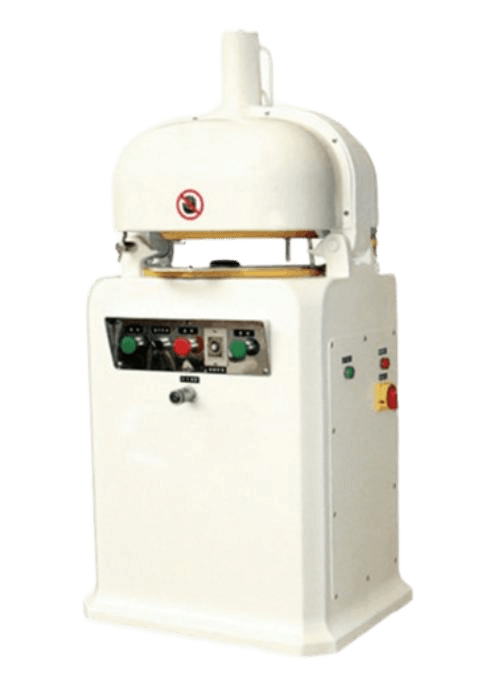
Sample output from the Industrial Dough Divider and Rounder. Ask us for real production photos matched to your exact product and capacity.

The DEC series divider and rounder portions dough into uniform pieces and rounds them into smooth balls — 1,000–12,000 pieces per hour typical at ±1 g accuracy, for bread, rolls, and buns.
The dividing head portions the dough mass by volume — three piston sets covering 30–500 g are included, swappable in 5 minutes without tools — then the conical rounding drum turns each piece into a smooth, tight ball with a flour-dusted surface. Even pieces make even loaves.
| Model | Output | Piece weight | Accuracy | Typical use |
|---|---|---|---|---|
| DEC-101 | 1,000–4,000 pcs/h | 30–500 g | ±1 g | Artisan and small plants |
| DEC-001 | 4,000–8,000 pcs/h | 30–500 g | ±1 g | Bread plants |
| DEC-201 | 8,000–12,000 pcs/h | 30–500 g | ±1 g | High-speed bun lines |
Typical values — piston set and drum speed configured to your piece weight and dough.
The range covers 50–75% hydration doughs; wetter doughs run with more dusting flour on the drum. Weight accuracy of ±1 g holds across the range — the number that keeps pack weights honest downstream.
Dough arrives from the SPM spiral mixer, leaves as balls into the PRO proofing chamber, and returns as risen product to the RTO rotary or CVO convection oven. The full dough line is on the bakery equipment hub.
Dividers work volumetrically, so piece weight accuracy follows dough consistency more than anything else. Set the portion by test-weighing a few pieces off the machine, fine-adjust the chamber or piston, then re-check through the run. Same recipe, same dough temperature, and a stable mixing routine are what hold accuracy hour after hour.
Yes, with different settings. Soft, enriched doughs need gentler handling and often a slower rounding track, while firm doughs take pressure without issue. The rounding cone and track are configured to your main dough type, and pressure is adjustable per product. Tell us your dough list and we confirm the setup for each.
Work backwards from the bowl. One spiral mixer batch should divide into whole cycles without a remainder, so choose hopper capacity and pieces-per-cycle against your bowl size. A well-matched pairing means the divider never waits on the mixer and the mixer never waits on the divider.
Output is pieces per cycle times cycles per hour, and the honest number depends on dough type and target accuracy, not the brochure peak. Firm dough divides faster than sticky dough, and frequent weight checks slow the line. We size the model against your required pieces per hour for your actual products.
Food-contact parts are built to strip down without tools: hopper, knife, and rounding surfaces come off for washing, and surfaces in dough contact are food-grade. A clean-down between dough types, especially between allergen-bearing recipes, is a few minutes of part removal and wash, not a teardown.
Yes. We provide installation and commissioning support, and 12 months of after-sales service, including spare parts help and technical response.

 7 * 24 Support
 Remote Support
 Global Coverage