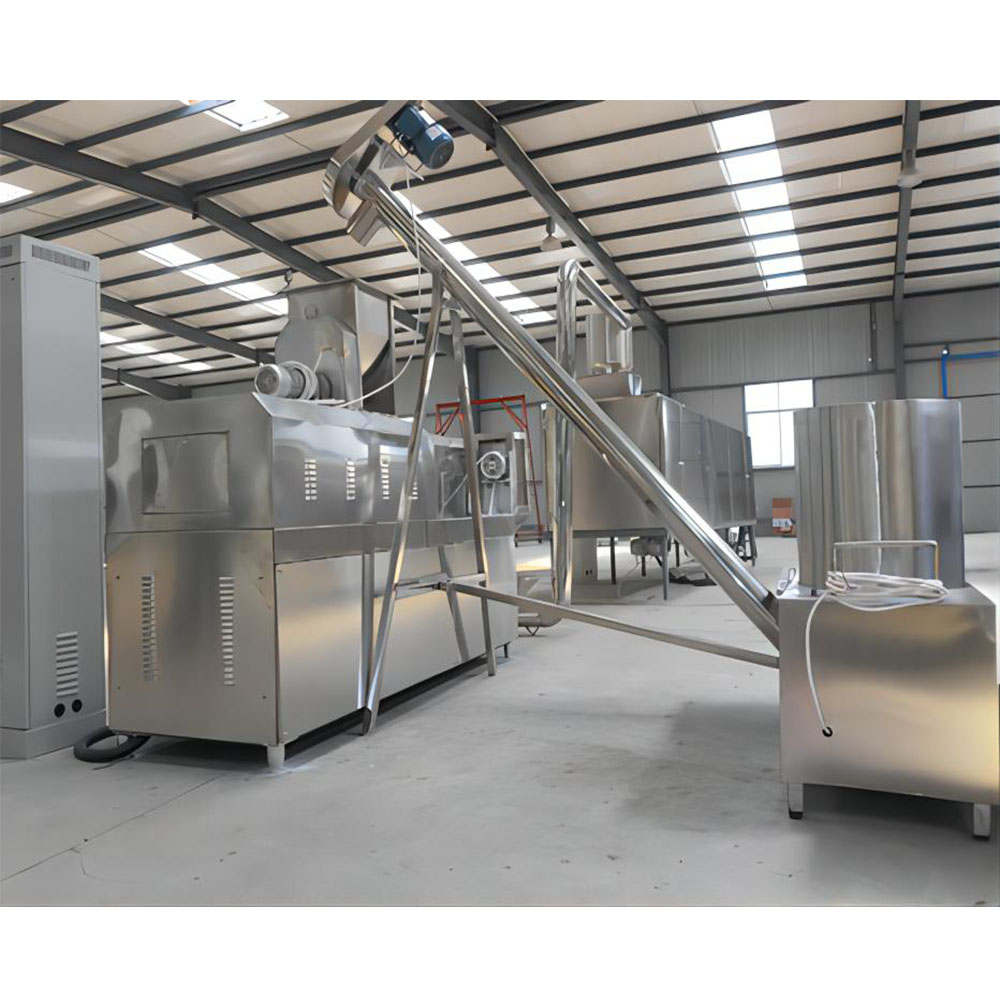
Food Machinery Import to Nigeria: 2026 Guide
Importing food processing machinery into Nigeria in 2026 requires navigating NAFDAC registration, SON certification, updated ECOWAS tariffs, and Lagos port clearance procedures while securing safe payment channels for Chinese suppliers. This guide walks B2B buyers in Lagos, Kano, Ibadan, and Port Harcourt through every regulatory, logistical, and financial step, with model-specific references from Esper Foodtech’s catalog. Whether you are buying a single CFP-001 chicken feet peeling line or a full CFP-100 snack plant, the roadmap below will help you avoid the delays, fines, and demurrage charges that trap unprepared importers.
- NAFDAC registration is mandatory for any machine that contacts food, and the application must be filed before the bill of lading lands at Tin Can or Apapa.
- SON Conformity Assessment Programme (SONCAP) certification is required for electrical and gas-powered machinery, and the Form M number must appear on the SONCAP certificate.
- Import duty on food processing machinery under HS 8438 ranges from 5 percent to 10 percent, with ETLS levy at 0.5 percent and VAT at 7.5 percent in 2026.
- Port clearance at Tin Can Island and Apapa averages 14 to 21 days; budget demurrage at roughly 50,000 NGN per day after the 14-day free period.
- Payment to Chinese suppliers should use confirmed Letters of Credit for orders above 50,000 USD; T/T advance plus balance against bill of lading copy is acceptable for smaller orders.
- Esper Foodtech models like CFP-100, CFP-200, CFP-300, and CFP-500 ship with CE certificates and factory test reports that satisfy both NAFDAC and SON documentation requirements.
Why Does Nigeria Is a Top Market for Food Machinery Importers in 2026?
Nigeria’s food processing sector is the largest in West Africa, driven by a population now exceeding 230 million, rapid urbanization in Lagos, Abuja, Kano, and Port Harcourt, and the federal government’s continued push for import substitution under the National Food Security Plan. The Central Bank of Nigeria’s restrictions on foreign exchange for finished food imports have pushed distributors, supermarket chains, and FMCG co-packers to invest in local production capacity. That shift has created strong, sustained demand for Chinese-built machinery that balances price, durability, and after-sales support.
For Nigerian buyers, China remains the most cost-effective sourcing destination for mid-tier food processing equipment. Esper Foodtech’s catalog spans the categories Nigerian processors buy most: poultry line equipment like the CFP-001 chicken feet peeling machine, tubular heat exchangers for juice and dairy, form-fill-seal packaging lines like the CFP-300 series, and complete snack food plants under the CFP-500 range. The 2026 fiscal year has also seen improvements at the Tin Can Island Container Terminal, with the new National Single Window platform cutting average clearance time from 28 days in 2023 to roughly 17 days today.
However, opportunity does not equal ease. NAFDAC’s reform of food-grade equipment registration, SON’s tighter enforcement of SONCAP on electrical machinery, and Nigeria Customs’ AI-assisted valuation database mean buyers can no longer rely on informal clearance agents to smooth the way. Every shipment must be documented end to end, and the cost of getting it wrong — container seizure, 35 percent penalty duties, even criminal prosecution — has never been higher.
NAFDAC Registration for Food Processing Equipment: What Counts and Why
The National Agency for Food and Drug Administration and Control (NAFDAC) regulates any machine that has direct contact with food, beverages, drinking water, food additives, or animal feed. In 2026, NAFDAC’s revised Food Inspection Service Guidelines tightened the definition to include not only processing machines but also ancillary equipment such as stainless steel conveyors, mixing vessels, packaging contact parts, and even some categories of food-grade pumps.
NAFDAC registration is not optional, and it is not the same as SON certification. The two regulators operate in parallel. NAFDAC’s concern is food safety — material toxicity, lead and cadmium levels on food contact surfaces, lubricant food-grade classification, and cleanability. SON’s concern is product safety — electrical insulation, mechanical guarding, and pressure vessel integrity. A machine like the CFP-200 industrial grinder must carry both: a NAFDAC food-grade certificate for the stainless steel hopper and auger, and a SONCAP certificate for the 415V three-phase motor and control panel.
The NAFDAC registration process for imported machinery follows five steps. First, the Nigerian importer (not the Chinese factory) opens a NAFDAC online account and uploads the company’s CAC certificate, manufacturer’s ISO 22000 or ISO 9001 certificate, and a signed authorization letter from Esper Foodtech. Second, NAFDAC issues a Request for Inspection, and an officer visits the warehouse or factory where the machine will be installed to confirm it matches the submitted technical file. Third, the importer submits a sample of food-grade material certificate (typically AISI 304 or 316 stainless), electrical drawings, and CE conformity documents. Fourth, NAFDAC reviews the file and issues a Registration Number valid for five years. Fifth, that Registration Number must be quoted on Form M and the SONCAP application.
Failure to register carries real consequences. NAFDAC officers conduct unannounced inspections of food factories in Lagos, Ibadan, and Kano, and an unregistered machine will be tagged and sealed pending compliance. Repeat offenses lead to factory shutdown. The current NAFDAC registration fee for industrial food machinery is 130,000 NGN per model line, plus a 0.4 percent inspection charge on the CIF value of the equipment.
SON Standards and SONCAP: The Technical Gate You Cannot Skip
The Standards Organisation of Nigeria (SON) operates the SON Conformity Assessment Programme, universally known as SONCAP, which applies to all regulated imports entering Nigeria by sea or air. Food processing machinery is squarely within the regulated list under SON IEC 60204-1 (electrical safety of machinery) and SON MS 960 (general machinery safety). In 2026, SON added a new clause requiring risk assessment documentation and a functional CE declaration for any machine rated above 7.5 kW.
SONCAP is issued in three stages. Stage one is Product Testing, done either at a SON-recognized lab in China (SGS, TUV, Intertek, or Bureau Veritas) or at the SON Industrial Lab in Lagos. Stage two is Pre-Export Verification, where an inspection body physically checks the goods at the Chinese factory or loading port. Stage three is the issuance of the SONCAP Certificate, which is mandatory before the Form M can be validated and the goods can be loaded. Without SONCAP, the Nigerian bank will not open the Letter of Credit, and Nigeria Customs will refuse to release the container.
Esper Foodtech ships every model with a third-party test report from TUV or SGS China, which covers the inspection cost and shortens the SONCAP timeline from 12 weeks to roughly 5 weeks. The buyer should request the following documents from Esper Foodtech at order stage: the CE Declaration of Conformity, the IEC 60204-1 test report, the mechanical guarding photo set, the hydraulic and pneumatic schematics if applicable, and the operator manual in English. For pressure-bearing equipment like the CFP-400 retort and the CFP-100 fryer, an additional ASME U-stamp or equivalent China SELO certificate is required.
The SONCAP Certificate must show three matching data points: the importer’s exact name as it appears on the Form M, the model number (for example, CFP-300) exactly as listed on the proforma invoice, and the HS code 8438.10 or 8438.80 depending on the machine type. Mismatched model numbers are the single most common cause of SONCAP rejection and add three to four weeks of re-issuance delay.
Import Duties, Levies, and Total Landed Cost Calculation in 2026
Nigeria’s tariff structure for food processing machinery under HS chapter 8438 has not changed dramatically in 2026, but the methodology for valuation has. Nigeria Customs Service now uses a Reference Vehicle and Machinery Valuation Database (RV-MVD), which means declared invoice values are automatically compared against a benchmark. Invoicing at unrealistically low values to reduce duty is no longer viable — Customs will reassess and bill the difference plus a 25 percent penalty.
| Cost Component | Rate / Amount (USD) | Basis |
| FOB Price, CFP-100 industrial fryer line | 38,000 | Proforma invoice from Esper Foodtech |
| Sea freight, Qingdao to Tin Can Island | 4,200 | 40-foot container, 2026 spot rate |
| Marine insurance | 320 | 0.75 percent of CIF |
| CIF value | 42,520 | Duty calculation base |
| Import duty, HS 8438.10 | 2,127 | 5 percent of CIF |
| ETLS (ECOWAS Trade Liberalization Scheme) levy | 213 | 0.5 percent of CIF |
| VAT | 3,357 | 7.5 percent of (CIF + duty + levies) |
| SON fee | 425 | 1 percent of CIF |
| NAFDAC fee | 170 | 0.4 percent of CIF |
| Clearing agent and terminal charges | 1,800 | Flat, Tin Can Island |
| Total landed cost | 50,612 | Approximately 19 percent on top of FOB |
Buyers should plan for a total landed cost roughly 18 to 22 percent above FOB, depending on exchange rate, terminal congestion, and demurrage. The 2026 exchange rate volatility — with the naira trading between 1,480 and 1,620 against the dollar — also means buyers should lock the rate at Form M opening, not at clearance, to avoid a 10 percent cost overrun caused purely by currency movement.
Port Clearance at Tin Can and Apapa: Step-by-Step Through Customs
Lagos has two main container ports: Apapa and Tin Can Island. Most Chinese machinery imports arrive at Tin Can, which handles roughly 65 percent of Nigeria’s containerized cargo. The clearance process begins the moment the vessel departs Qingdao or Shanghai, because several preparatory documents must be in place before arrival to avoid a multi-week queue.
Two weeks before vessel arrival, your licensed Customs agent should file the Form M through the Nigerian Trade Portal, attaching the proforma invoice, the SONCAP certificate, and the NAFDAC registration number. The bank will then issue a Bill of Lading release. Within 48 hours of vessel arrival, the agent files the SGD (Single Goods Declaration) and pays duty through the designated bank. Once duty is paid, the container is scanned. Green-lane containers clear within two days; yellow lane requires physical inspection adding four to six days; red lane means full examination and can add 10 to 14 days.
Common red-lane triggers for food machinery include discrepancies between declared HS code and actual product, missing CE certificates in the file, low declared values versus the Customs valuation database, and previous compliance issues with the importer’s name. Buyers importing Esper Foodtech models for the first time should expect a yellow lane on the first shipment and plan accordingly.
Demurrage is the silent budget killer. Terminal operators at Tin Can (TICT and Ports and Cargo) allow 14 free days, after which the daily charge runs 45,000 to 60,000 NGN for a 40-foot container. Apapa’s free period is shorter, just 10 days. A container stuck in inspection for 21 days can accumulate 7 to 9 days of demurrage, adding 500,000 NGN or more to the project cost. The fix is simple: pre-clear documents, pay duty before vessel arrival where possible, and use an agent who specializes in industrial machinery rather than general cargo.
Tip: Hire a licensed Customs agent who has cleared food machinery before. A general-purpose agent may charge less, but each extra day in inspection will cost more than the agent’s fee for the entire job.
Payment to Chinese Machinery Suppliers: Safe Channels and Risk Allocation
Paying a Chinese supplier the wrong way can sink a project as fast as a regulatory mistake. Nigerian foreign exchange controls, the CBN’s prioritization of visible exports, and the rise of sophisticated supplier fraud in the Shandong and Guangdong machinery hubs mean buyers must structure payment with care. There are three main payment channels, each appropriate for a different order size and risk profile.
For orders under 30,000 USD — for example, a single CFP-001 chicken feet peeling machine or a CFP-200 industrial grinder — a telegraphic transfer (T/T) split as 30 percent advance against proforma and 70 percent against a faxed or emailed copy of the bill of lading is standard. The risk is that the supplier can ship inferior equipment and the buyer has already released 30 percent. Mitigate this risk by using an escrow service such as Alibaba Trade Assurance, Sinosure’s Buyer Credit Insurance, or a third-party pre-shipment inspection by SGS China.
For orders between 30,000 USD and 100,000 USD — a typical range for a CFP-300 form-fill-seal line or a small CFP-100 production module — a confirmed Letter of Credit is the gold standard. The LC is opened by the Nigerian buyer’s bank in favor of Esper Foodtech’s Chinese bank, and payment is released only when the supplier presents the conforming documents: signed commercial invoice, full set of clean on board ocean bills of lading, packing list, CE certificate, SONCAP certificate, and a pre-shipment inspection certificate from a nominated agency. LC confirmation adds 1.5 to 2.5 percent in bank fees, but it eliminates 90 percent of supplier-side risk.
For orders above 100,000 USD — typically a complete CFP-500 snack food plant or a multi-line greenfield factory — buyers should consider a Usance (deferred) LC at 90 or 180 days, sometimes backed by Sinosure short-term export credit. This structure gives the buyer time to install, commission, and start production before paying the bulk of the invoice. The interest rate in 2026 averages LIBOR plus 2.8 percent, which is competitive against Nigerian bank working capital loans that currently sit at 28 to 32 percent per annum.
- Always verify the supplier’s bank account name matches the company on the proforma invoice exactly — a single-letter mismatch is a classic fraud signal.
- Never pay the full balance via Western Union, personal account, or cryptocurrency. Legitimate Chinese manufacturers accept only corporate T/T or LC.
- Insist on a factory acceptance test (FAT) video call before the 70 percent balance is released. Esper Foodtech offers live FAT in Qingdao for all models above 15,000 USD.
- Use Sinosure for credit protection on any order above 50,000 USD; the premium is roughly 0.5 percent and covers 90 percent of invoice value in case of buyer default.
- Keep the Form M, SONCAP, and LC documents in a single PDF binder — Nigeria Customs, NAFDAC, and the bank will all request them on different timelines.
Choosing the Right Esper Foodtech Model for the Nigerian Market
Nigerian food categories map neatly onto Esper Foodtech’s model families, and the right choice depends on the buyer’s product mix and capacity target. The poultry processing cluster, dominated by broiler and layer integrators in Ibadan, Abeokuta, and Kaduna, is best served by the CFP-001 chicken feet peeling line and the CFP-002 chicken cut-up machine. Throughput ranges from 500 to 4,000 birds per hour, and the entire line fits in a single 40-foot container, keeping logistics simple.
The snack and convenience food cluster — plantain chips, chin-chin, cassava crackers, peanut brittle — is concentrated in Lagos and Kano. Buyers typically combine the CFP-300 form-fill-seal wrapper with the CFP-100 continuous fryer and a CFP-200 seasoning tumbler. This three-machine configuration supports outputs of 200 to 800 kg per hour and is the most popular configuration sold to Nigerian processors in the past 18 months.
The beverage and dairy cluster requires heat treatment. The CFP-400 tubular UHT and the CFP-400R retort are designed for Nigerian yogurt, zobo, soy milk, and packaged juice producers. Power supply is a critical selection criterion here — Nigeria’s grid is unstable, and the CFP-400 family is engineered for 415V three-phase plus a 60 kVA backup generator hook-up, which matches the standard Lagos industrial setup.
The composite plant line, the CFP-500, is the right choice for buyers building a turnkey snack or instant noodle factory. It integrates mixing, extrusion, frying or baking, seasoning, and packaging into a single synchronized line. Lead time from Qingdao to commissioning in Lagos is 16 to 22 weeks, and the full line typically occupies two 40-foot containers. Buyers should allocate at least 10 percent of the line cost for installation, training, and a one-year spare parts package.
Frequently Asked Questions
Q: Do I need NAFDAC registration if I am only using the machine in my own factory and not selling the machine itself?
A: Yes. NAFDAC registration covers the food produced by the machine, not just the machine as a tradable item. If your factory produces packaged food for sale in Nigeria, every machine that contacts the food must be registered. NAFDAC officers will check registration certificates during factory inspections, and unregistered equipment can lead to product seizure even if the food itself meets standards.
Q: How long does the full clearance process take from the day the order is placed with Esper Foodtech?
A: Count on 14 to 18 weeks end to end for a typical order. Manufacturing takes 6 to 10 weeks depending on the model, SONCAP processing takes 4 to 6 weeks, sea freight from Qingdao to Tin Can Island takes 28 to 35 days, and Nigerian customs clearance takes 2 to 3 weeks. Larger lines like the CFP-500 may extend to 22 weeks. Planning backwards from your target commissioning date is essential.
Q: Can I pay the supplier in naira or must I convert to dollars?
A: All Chinese machinery imports must be settled in USD or, in some cases, RMB through the official bilateral trade window. The Nigerian buyer opens a Form M through an authorized dealer bank, the bank sources forex from the CBN weekly auction or the Investors and Exporters window, and the bank wires USD to the supplier’s Chinese bank. Direct naira payment is not permitted for imports above 5,000 USD.
Q: What happens if the container is flagged for the red lane at Tin Can Island?
A: The container will be moved to the examination bay for full physical inspection. Your agent must be present with the technical file, the SONCAP certificate, and a letter explaining the equipment’s function. Inspection typically takes 7 to 14 days. If the contents match the declared documents, the container is released. If discrepancies are found, Customs may reassess the value, levy additional duty plus penalty, or in serious cases seize the goods. A properly documented Esper Foodtech shipment passes red-lane inspection in over 95 percent of cases.
Q: Does Esper Foodtech provide installation and training in Nigeria?
A: Yes, for orders above 50,000 USD, Esper Foodtech sends a Chinese engineer to Lagos, Abuja, or Kano for 7 to 15 days of installation, commissioning, and operator training. The buyer covers visa, flights, local transport, hotel, and a 150 USD per day living allowance. For smaller orders, remote video installation support is provided free for the first 12 months. Always confirm installation scope in the contract before the LC is opened.
Q: Are spare parts available locally in Nigeria?
A: Common consumables such as seals, bearings, blades, and filters are stocked by Esper Foodtech’s Lagos partner warehouse near Ikeja. Specialized parts for the CFP-400 retort, CFP-500 extruder, and CFP-300 wrapper control board are shipped from Qingdao with a typical lead time of 6 to 8 weeks by air freight. Buyers are strongly advised to purchase a one-year spare parts kit at order stage, discounted to roughly 4 percent of the machine price.
Plan Your Import Project with Esper Foodtech
Importing food machinery into Nigeria in 2026 is more navigable than it was five years ago, but it still rewards preparation and punishes improvisation. Buyers who register with NAFDAC early, secure SONCAP before shipment, lock the FX rate at Form M, and use confirmed LC payment for substantial orders consistently land their machinery on time and on budget. The buyers who struggle are those who treat documentation as an afterthought and rely on informal agents to fix problems at the port.
Esper Foodtech has shipped more than 380 food processing machines to Nigeria in the past three years, with the CFP-100, CFP-300, and CFP-500 families being the proven workhorses for Nigerian processors. Our team handles SONCAP documentation, CE certificates, FAT scheduling, and after-sales support across Lagos, Ibadan, Kano, and Port Harcourt. Whether you are scaling from a single CFP-001 peeling line to a full CFP-500 turnkey plant, we can help you scope the right equipment, structure the payment safely, and clear customs without surprises.
To request a tailored quotation, a SONCAP-ready technical file, or a free 30-minute consultation on your 2026 import project, contact our export desk directly: [email protected]. Our team responds within one business day and ships from Qingdao every Tuesday and Friday.
Learn more: cooking oil processing applications
Get a quote: [email protected]