Industrial Metal Detector for Food
Food-grade metal detector: detects ferrous, non-ferrous, and stainless steel contaminants on conveyor belt or in pipeline.
This site uses cookies for analytics and to improve your experience. By clicking Accept, you consent to our use of cookies. Learn more in our privacy policy.

Food-grade metal detector: detects ferrous, non-ferrous, and stainless steel contaminants on conveyor belt or in pipeline.
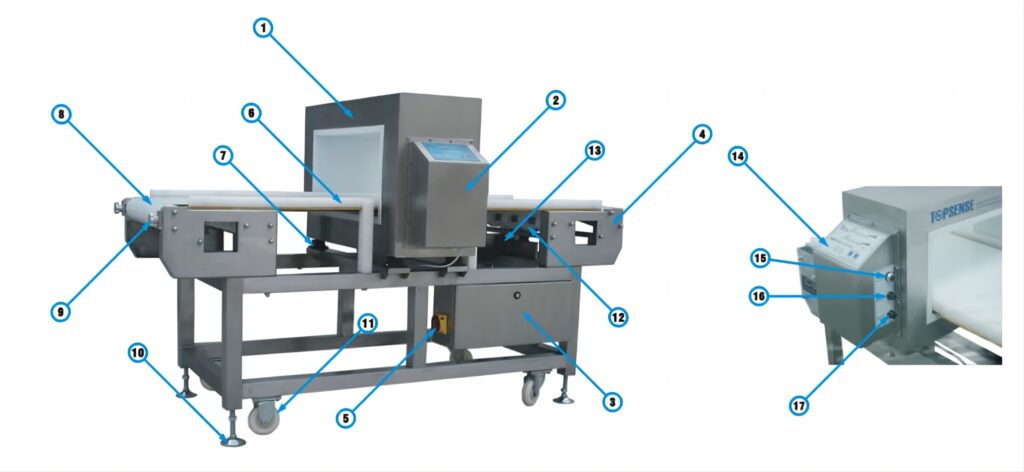
Sample output from the Industrial Metal Detector. Ask us for real production photos matched to your exact product and capacity.

Food-grade metal detector: detects ferrous, non-ferrous, and stainless steel contaminants on conveyor belt or in pipeline. Belt speed 5-50 m/min.
| Model | Capacity | Configuration |
|---|---|---|
| MTD-101 | 500mm belt | Belt aperture. Small products. |
| MTD-001 | 800mm belt | Conveyor + auto-reject. Mid-scale. |
| MTD-201 | Pipeline | Pipeline for liquid/paste. Industrial. |
Typical values — each model is configured to your product, cut size, and line speed.
Packaging lines rejecting metal contamination before shipment. For the full range, see the processing hub.
In typical food applications, expect to find ferrous pieces around 0.8 to 1.0mm, non-ferrous around 1.2 to 1.5mm, and stainless steel around 1.5 to 2.0mm, with sensitivity depending on aperture size and product effect. A smaller aperture detects smaller contaminants, so keep the opening close to your product. We confirm achievable test-piece performance on your actual product before shipping.
Yes. Wet, conductive products generate product effect that masks small metal signatures, so standard single-frequency detection degrades. The answer is multi-frequency or RF technology built for conductive products, which separates the product signal from the contaminant signal. Dry snacks, cereals, and powders run on the standard configuration. Send the product with its salt and moisture profile and we set the right platform.
The line does not stop. A pneumatic pusher or air-blast ejector removes the flagged pack from the belt into a secured reject bin while good product continues. Reject confirmation is monitored, so an ejector that fails to fire alarms rather than passing suspect product. Belt speed runs 5 to 50 m/min with detection and ejector synchronized on the same tracking.
Run certified test wands in ferrous, non-ferrous, and stainless steel at start-up, through the shift at a typical interval of every two hours, and at shutdown. Each test and each reject is logged with timestamp, product type, and contaminant type. Those records are exactly what an auditor asks for under HACCP. The test routine takes minutes, and we supply the wand set.
Yes. Reject events, test results, and performance data are logged and can be reported to your line PLC and plant systems, so metal control becomes part of the batch record rather than a separate clipboard. Monthly sensor calibration and an annual conveyor check are the maintenance routine. Integration details like signal handshakes and report formats are agreed before delivery.
Yes. We provide installation and commissioning support, and 12 months of after-sales service, including spare parts help and technical response.

 7 * 24 Support
 Remote Support
 Global Coverage