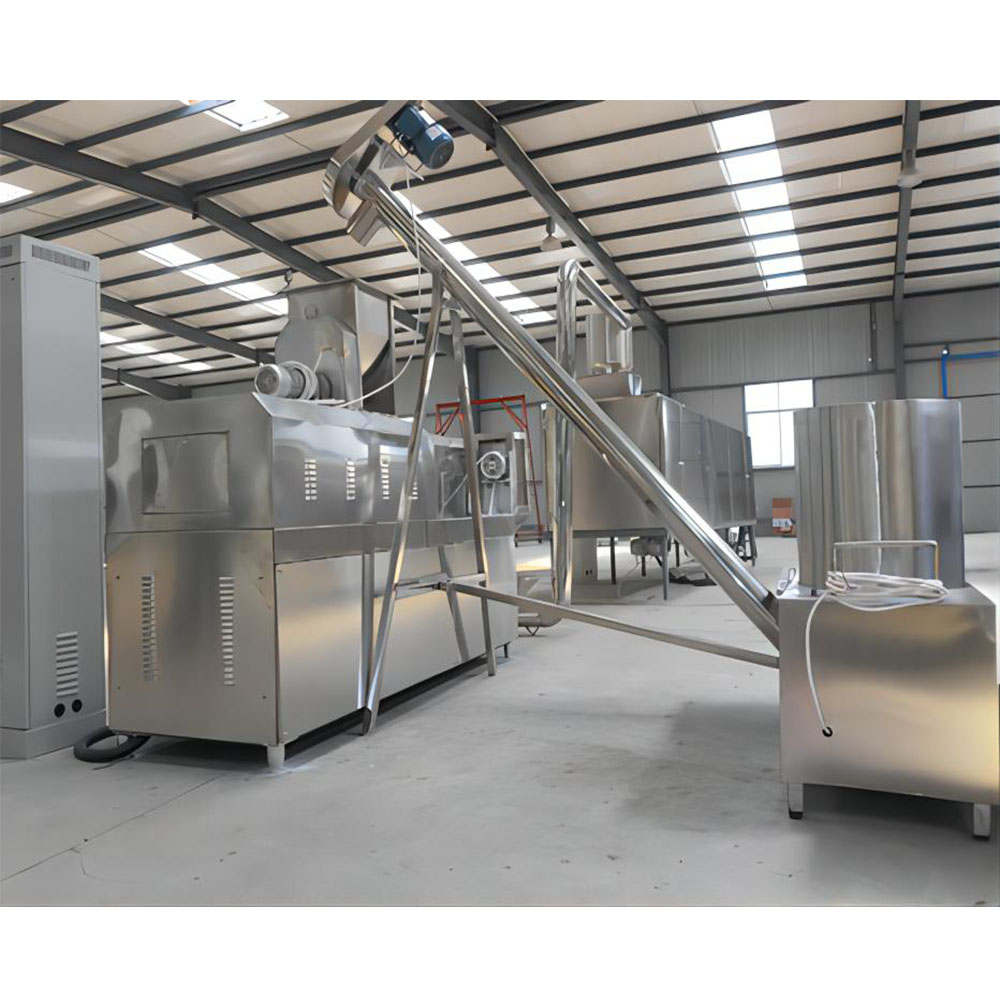
Meatball Former Dropping Product: Quick Fix Guide
When a MBF-001 or SMB-001 continuous meatball former starts dropping product from the mold cavity, misshaping balls on the discharge belt, or leaving ragged tails on the wire-cut station, the problem is almost never random. In 90% of service calls we log on Esper Foodtech lines, the root cause traces back to one of five faults: batter viscosity drift, mold cup wear, filling pressure imbalance, water bath temperature error, or wire-cut timing misalignment. This guide walks an experienced operator through each fault in the order you should check them — fastest, cheapest checks first — so you stop the product loss without ordering parts you do not need.
Typical symptom onset looks like this: the line ran clean on Friday afternoon, sat through the weekend cold, and on Monday morning the first 200 to 400 balls out of the former are flat, split, or stuck to the mold cup. Operators blame the meat. Supervisors blame the operator. The real culprit is usually a 4-degree drop in the forming water bath or a 15-psi drop in the hopper air supply after a weekend of valve weep. The diagnostic steps below isolate the fault in under 15 minutes.
What Are the Symptoms? Identify Your Fault Pattern
Before pulling any tools, watch the former run for two minutes and tick off every symptom that applies. The pattern itself tells you which of the five root causes is in play.
- Meatball drops from the upper mold half before the lower cup opens — points to filling pressure or mold wear
- Ball forms but leaves a 10-20mm tail of meat hanging off the back — points to wire-cut timing or batter viscosity
- Ball comes out flat on one side, round on the other — points to mold cup wear or uneven hopper pressure
- Ball splits cleanly down the centerline as it hits the discharge belt — points to water bath temperature below 80°C or batter too tight
- First 50-100 balls after startup are misshapen, then line stabilizes — points to cold start, not a parts failure
- Reject rate climbs steadily over a 4-hour run — points to batter viscosity drift as hopper temperature rises
- Reject rate is constant from ball one — points to mechanical wear or pressure setting
- Formed ball sticks in the lower cup and needs a scraper to release — points to mold cup coating wear or water bath too hot
What Causes Batter Viscosity Drift Outside the 18-22 Second Window?
Batter viscosity is the single most common cause of dropped or misshapen meatballs, and it is the cheapest to fix. The MBF-001 and SMB-001 formers are calibrated to run a batter that flows through a Ford B4 cup at 19 to 21 seconds at 12°C. When viscosity drops below 16 seconds (batter is too thin), the meat slumps in the mold before the wire cut fires. When viscosity climbs above 24 seconds (batter is too thick), the meat tears at the cut and leaves a tail.
Diagnosis steps:
- Pull a 200ml batter sample directly from the hopper, not from the mix tank. Hopper batter has been through the pump and reflects what the mold actually sees.
- Run the Ford B4 cup test at line temperature. Record the seconds. Anything outside 18-22 seconds is a fault.
- Check hopper temperature with a probe thermometer. If the hopper is above 14°C, the batter has warmed and thinned — refrigeration fault or long dwell time.
- Check the last batter mix log. If the operator cut water by 0.5kg to “fix” a soft-meat batch, the batter is now too thick.
Fix: Adjust water back to the recipe spec (typically 12.0kg water to 8.5kg dry blend for a standard 70/30 beef/pork ball). If viscosity reads below 16 seconds, add 200g of dry blend and re-circulate for 4 minutes before retesting. If viscosity reads above 24 seconds, add 300g of chilled (4°C) water and re-circulate. Never add ice directly to the hopper — it shocks the protein and causes instant tightening. Discard any batter older than 4 hours at hopper temperature; the enzymes have already started breaking the structure and no amount of adjustment will save it.
What Causes Mold Cup Wear Beyond the 0.15mm Edge Radius Limit?
The forming cups on a MBF-001 are CNC-machined from 304 stainless with a PTFE-impregnated nickel coating. The cup edge starts life with a 0.08mm radius — sharp enough to cut the batter clean, rounded enough to release the ball without tearing. After 800 to 1,200 production hours (depending on meat grit content), that edge wears to a 0.15mm radius and the ball starts sticking, tearing, or dropping. The SMB-001 uses a smaller cup with a shorter 500-700 hour life because the higher cycle rate (120 balls/min versus 80 balls/min on the MBF-001) accelerates wear.
Diagnosis steps:
- Stop the line. Remove the upper mold half (four M6 cap screws, 4mm Allen key).
- Run a fingernail across the cup edge. If the edge feels square or rolled over (like a dull knife), the cup is worn.
- Use a 0.15mm feeler gauge pressed flat against the cup wall. If you can see daylight between the gauge and the wall at the edge, the radius has exceeded tolerance.
- Check the cup interior for a visible wear ring — a frosted band 2-3mm down from the edge where the meat rubs. A wear ring deeper than 0.5mm means the cup is at end of life.
- Cross-check with cycle count on the HMI. MBF-001 cups past 900,000 cycles or SMB-001 cups past 1.2 million cycles are due for replacement regardless of visual condition.
Fix: Order replacement cup set P/N MBF-CUP-22M (MBF-001) or SMB-CUP-18M (SMB-001). Do not attempt to re-machine the cup in-house — the PTFE-nickel coating must be reapplied by the OEM or the cup will stick within 50 hours. Swap cups as a matched upper/lower set; mixing a new upper with a worn lower creates a 0.05mm mismatch that produces flat balls. Re-torque the M6 cap screws to 9 Nm in a cross pattern, not sequentially.
What Causes Filling Pressure Imbalance — Hopper Below 42 psi or Above 58 psi?
The MBF-001 hopper runs on a regulated air supply at 50 psi nominal, with a healthy band of 42 to 58 psi. Below 42 psi, the meat does not fully fill the mold cavity and you get short-weight or flat-sided balls. Above 58 psi, the meat packs so tight against the lower cup that the release stroke tears the ball in half. The SMB-001 runs a tighter 46-54 psi band because its smaller cup is more sensitive to overfill.
Diagnosis steps:
- Read the hopper pressure gauge on the back of the former with the pump running and the hopper full. Static reading (pump off) tells you nothing.
- If pressure reads low (under 42 psi), check the main air supply at the wall — should be 90 psi minimum. A weekend leak in the plant air system can drop supply to 70 psi and starve the former.
- Watch the gauge needle while the pump cycles. If the needle bounces more than 4 psi between strokes, the accumulator bladder is burst and needs replacement (P/N ACC-2L-PTFE).
- Pull the relief valve and check for meat residue in the seat. A fouled relief valve weeps pressure and is the most common cause of slow drift down to 38 psi over a 6-hour run.
- Verify the pressure transducer on the HMI matches the mechanical gauge. If they differ by more than 3 psi, calibrate the transducer against a known reference gauge.
Fix: Set the wall regulator to 95 psi, then adjust the hopper regulator to 50 psi (MBF-001) or 50 psi (SMB-001) with the pump running. Replace the accumulator bladder if needle bounce exceeds 4 psi. Clean the relief valve seat with a non-abrasive pad and food-grade solvent — never use a wire brush on the seat, it will score the surface and cause permanent weep. If the transducer is out of calibration, follow the HII service menu (hold F2 + F4 on power-up) to enter the 2-point calibration routine against the mechanical gauge.
What Causes Water Bath Temperature Drift Below 82°C?
The cook water bath on a continuous former line must hold 82 to 85°C at the inlet and 88 to 92°C at the discharge end. When the inlet drops below 80°C, the meatball surface does not set fast enough and the ball slumps or splits as it travels. When the discharge exceeds 94°C, the outer protein layer over-cooks, shrinks unevenly, and the ball cracks. The fault is almost always a steam valve limping or a level controller adding cold makeup water faster than the heat exchanger can recover.
Diagnosis steps:
- Verify bath temperature with a handheld probe thermometer at three points: inlet (just past the former drop), mid-bath, and discharge. Do not trust the HMI thermocouple alone — it sits in a stilling well that lags actual bath temp by 30-60 seconds.
- Check the steam solenoid (P/N SOL-STeam-3-4) by listening for the click when the bath calls for heat. No click means the solenoid coil is dead. Click but no temperature rise means the valve seat is fouled.
- Watch the makeup water valve. If the bath level drops more than 15mm and the makeup valve opens for more than 8 seconds at a stretch, the incoming cold water is overwhelming the heat exchanger.
- Inspect the steam trap at the bath return. A failed-open trap passes live steam to condensate and robs the heat exchanger of latent heat. Trap should cycle; constant flow is a fault.
- Check bath water pH. Below 6.0, the water foams and insulates the meatball surface, slowing the set. Above 8.0, protein extraction accelerates and the ball skins over too fast.
Fix: Replace steam solenoid coil (15-minute job, no special tools). If the valve seat is fouled, isolate steam, disassemble the valve body, and clean the seat with a brass brush — not steel. Adjust the makeup water valve orifice down to a 4-second fill cycle. Replace the steam trap with the same model (different trap capacities behave differently and will detune the bath). If pH is off, drain 20% of the bath and refill with softened water — full bath changes should happen every 8 production hours on a 2-shift line.
What Causes Wire-Cut Timing Drift on the SMB-001 High-Speed Station?
The SMB-001 runs a rotary wire-cut at 120 cuts per minute. The cut must fire when the mold is at bottom dead center (BDC) plus 2 degrees of crank rotation — a window of about 8 milliseconds. When the timing drifts (usually from a stretched timing belt or a loosened encoder coupling), the wire cuts meat that is still moving, producing tails, doubles, or flat-top balls. The MBF-001 runs at 80 cuts per minute and is more forgiving, but the same fault applies.
Diagnosis steps:
- Set the HMI to manual mode and jog the crank to BDC. The timing mark on the flywheel should align with the fixed pointer within one tooth of the encoder wheel.
- Switch to production speed and watch the cut through the observation window. The wire should enter the meat at the same crank angle every cycle — if it wanders, the encoder coupling is loose.
- Check the timing belt tension with a Gates Sonic Tension Meter. MBF-001 spec is 45-50 Hz. SMB-001 spec is 55-60 Hz. Below spec, the belt slips one tooth per 10 minutes of running.
- Inspect the cut wire (P/N WIRE-0.8mm-Tungsten) for nicks. A nicked wire drags through the meat instead of slicing, leaving a tail even when timing is correct.
- Check the wire tension spring. Spec is 18N for MBF-001, 22N for SMB-001. A fatigued spring drops tension by 4-6N over 200 hours of running.
Fix: Re-time the encoder coupling to the timing mark, then torque the coupling clamp to 2.5 Nm. Replace the timing belt if tension cannot be brought back into spec with the idler adjustment — a stretched belt will continue to drift. Replace the cut wire every 80 production hours as preventive maintenance; waiting for a failure costs you 30 minutes of downtime and a half-hour of cleanup. Set wire tension with a calibrated fish-scale or the HII tension fixture, not by feel.
Diagnostic Quick-Reference Table
| Symptom | Most Likely Fault | Diagnostic Number | First Action |
|---|---|---|---|
| Ball drops before cup opens | Filling pressure too low | Hopper gauge under 42 psi | Reset regulator to 50 psi |
| 10-20mm tail on ball | Batter too thick or wire timing off | Ford cup over 22 sec | Add 300g chilled water |
| Ball splits down centerline | Bath temperature low | Inlet under 80°C | Check steam solenoid |
| Flat-sided balls, constant reject rate | Mold cup wear | Cup cycle count over 900k | Replace cup set |
| Ball sticks in lower cup | PTFE coating worn or bath too hot | Discharge over 94°C | Reduce steam input |
| Reject rate climbs over run | Hopper warming, batter thinning | Hopper over 14°C | Check hopper refrigeration |
| First 100 balls bad, then stable | Cold start, not a fault | Bath under 75°C at startup | Extend preheat to 25 min |
| Pressure gauge needle bounces | Accumulator bladder failed | Needle travel over 4 psi | Replace bladder P/N ACC-2L-PTFE |
The order of diagnosis matters. Always check batter viscosity and hopper pressure before pulling a mold or replacing a wire. 70% of “bad mold” service calls we open turn out to be a viscosity or pressure fault that costs nothing to fix. The 15 minutes you spend on the Ford cup and the pressure gauge saves you a 4-hour parts swap and a $400 cup set you did not need.
Frequently Asked Questions
How often should I replace the cut wire on an SMB-001 running 120 balls per minute?
Plan on every 80 production hours under normal meat load, or 60 hours if you are running a high-collagen beef blend that is abrasive. The wire itself is cheap (under $15) but a failed wire mid-run costs you 30 minutes of downtime plus cleanup of the discharge belt. Set the wire change as a standing PM task tied to cycle count on the HII, not a reactive swap.
Can I run a MBF-001 on a batter thicker than 22 seconds if I bump the hopper pressure?
You can, but you will pay for it in mold wear. Thick batter (above 24 seconds) packs harder into the cup and accelerates edge wear by a factor of roughly 2.2x. You will also see more tail defects because the wire cannot slice cleanly through tight batter. The correct response to a thick batter is to thin it with chilled water, not to push the equipment harder. If your recipe consistently calls for thick batter, talk to us about a larger-cup configuration (MBF-001-L cup set) designed to handle it.
My water bath holds 85°C at the inlet but the discharge reads 96°C. Is that a problem?
Yes. Discharge above 94°C means the meatball outer layer is over-cooking and shrinking while the core is still raw. You will see cracked surfaces, flat spots where the ball rides the belt, and a 3-5% weight loss to purge. Reduce the steam input at the discharge zone, check the steam trap on that loop, and verify the bath recirculation pump is moving water at the rated 40 liters per minute. A slow pump lets hot water stratify at the discharge end.
What is the difference between MBF-001 and SMB-001 cup life, and can I swap cups between them?
The MBF-001 cup runs 800-1,200 hours; the SMB-001 cup runs 500-700 hours due to the higher cycle rate. The cups are not interchangeable — different bolt pattern, different cup depth, different edge geometry. Attempting to swap them will not only produce bad balls but will damage the mold plate threads. Always order cups by the exact model designation on your machine’s data plate.
The former runs clean for 2 hours, then reject rate climbs. Why?
This is classic hopper warming. As the batter sits in the hopper, friction from the pump and ambient heat raise the batter temperature 1-2°C per hour. By hour 3, a batter that started at 12°C is now at 15-16°C and has thinned from 20 seconds to 16 seconds on the Ford cup. The fix is hopper jacket refrigeration — verify the glycol loop is flowing and the jacket temperature is holding at 8-10°C. If glycol flow is fine, your batter recipe is too temperature-sensitive and you need to add a stabilizer or reduce batch size so dwell time in the hopper stays under 90 minutes.
Can I clean the mold cups in a standard cage washer?
No. The PTFE-nickel coating will not survive the caustic cycle in a standard cage washer — the sodium hydroxide attacks the nickel underlayer and the coating lifts within 5 wash cycles. Clean cups by hand with a non-abrasive pad and food-grade detergent, or in a low-caustic (under 0.5% NaOH) ultrasonic bath at 50°C maximum. A cup set cleaned correctly lasts 4-5x longer than one run through a cage washer.
When Should You Call Esper Foodtech Field Service?
If you have walked through all five root causes above and the reject rate is still above 3%, do not keep swapping parts. At that point the fault is either a combination issue (worn mold and drifting pressure and bath temperature) that needs a systematic recommissioning, or it is something deeper — a cracked mold plate, a fatigued crank bearing, or a controller that has lost its calibration. These faults require a field technician with the right tooling and a fresh set of baseline numbers.
Email [email protected] with the following information so we can dispatch the right technician with the right parts the first time:
- Machine model and serial number (from the data plate on the electrical cabinet)
- Total cycle count and hours since last mold cup replacement
- Current reject rate as a percentage and the symptom pattern from the checklist above
- Ford B4 cup viscosity reading and hopper temperature at the time of the fault
- Hopper pressure and water bath inlet/discharge temperatures
- Two or three photos of the rejected meatballs on a clean surface, with a ruler for scale
With that information, our field team can typically diagnose the fault remotely and either walk your operator through a fix on the phone or schedule a visit with the correct parts on the truck. Most calls are resolved inside 48 hours of contact. Do not run a former at high reject for more than one shift — every misshapen ball is meat, batter, and labor that you cannot recover, and the wear you put on the mold and wire chasing a fault accelerates your next parts bill.
Learn more: cooking oil processing applications
Get a quote: [email protected]