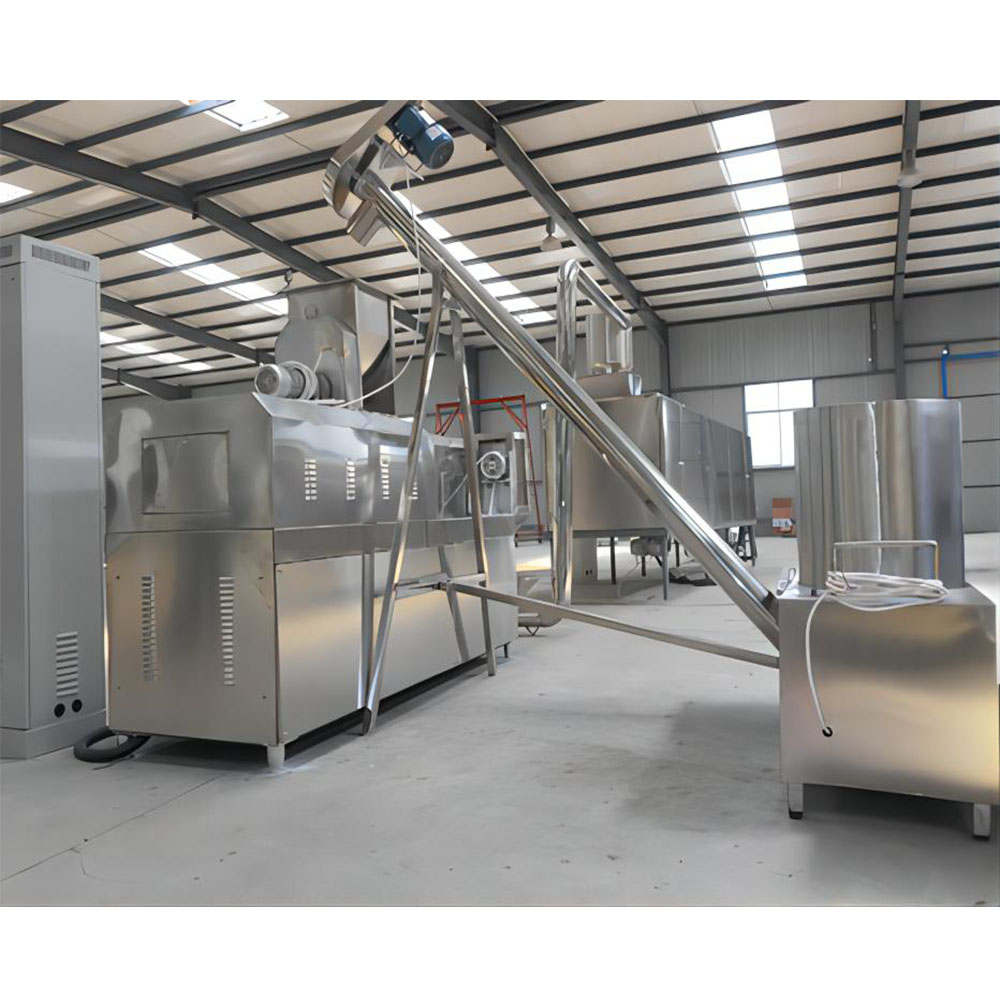
Popcorn Machine Not Popping Fully: Troubleshooting
If you are running a commercial popcorn line and your popcorn machine is leaving a third of every batch as unpopped “grannies,” you are not just throwing away corn — you are throwing away oil, electricity, labor hours, and the gross margin on every case you ship. On a typical CFP-450 continuous popped corn line running 280 kg/h, every 1 percent of unpopped kernels represents roughly 2.5 kg of lost salable product per hour, or about 20 kg per 8-hour shift. After a week, that is a full pallet of waste that you paid to grow, transport, hydrate, and heat. The good news is that an under-performing popper is almost never a single mystery fault. It is one of seven root causes — oil temperature, kernel moisture, drum rotation, variety mismatch, sump loading, steam back-pressure, or exit-air temperature — and each one can be isolated, measured, and corrected in under 30 minutes if you know what numbers to chase. This guide is written as a field-engineering walk-through for the Amisy CFP series and equivalent Esper Foodtech popping systems, and it gives you the exact thresholds we use on commissioning calls.
What Are the Symptoms? Confirm You Actually Have a Yield Problem
Before you tear into the popper, confirm that the problem is real and not a weighing error. Run the standard 15-minute catch test: place a clean 25 kg tote under the discharge of the cyclone, run the line for exactly 15 minutes at nominal rate, then hand-screen the output through an 8 mm round-hole sieve. Weigh the throughs (popped flakes), weigh the overs (unpopped and partially popped kernels), and calculate the ratio. Use this checklist:
- Unpopped kernel rate above 4 percent by mass on at least two consecutive 15-minute catches (industry acceptable ceiling is 3 percent; world-class is 1.5 percent).
- Visible “grannies” in the finished tote — more than a shallow handful per 25 kg scoop.
- Partially popped kernels (“split-open but still dense”) exceeding 2 percent — a different failure mode than pure unpopped.
- Charred or scorched flakes mixed with unpopped corn — almost always a temperature problem, not a moisture problem.
- Oil pooling in the tote or visible oil streaks on the drum interior after shutdown — points to excess oil or insufficient rotation.
- Steam or vapor visible at the kernel infeed — indicates back-pressure from a blocked exhaust.
- Drum interior coating of carbonized oil thicker than 1 mm when checked with a putty knife — old oil reducing heat transfer.
If two or more of these are present, work through the seven sections below in order. The order matters: oil temperature is the cause in roughly 60 percent of callouts, kernel moisture in another 20 percent, and everything else splits the remaining 20 percent.
What Causes Oil Temperature Drift on the CFP-450 and CFP-700 Hot-Oil Poppers?
Oil temperature is the dominant variable in popping yield. Mushroom-type kernels need an oil temperature of 225 to 235 °C at the kernel entry point; butterfly-type kernels want 218 to 228 °C. If your oil sump thermometer reads 215 °C, the kernel will rupture its hull but will not build enough internal steam pressure to fully inflate the starch — you get half-popped “toad” kernels. If it reads above 245 °C, you scorch the oil, char the flakes, and still lose yield because the outside of the kernel burns before the inside gelatinizes.
Diagnosis: Verify the actual oil temperature, not the setpoint. The PID display on the Amisy CFP-450 control panel reads the RTD in the sump, but the kernel sees the oil as it leaves the spray bar — that temperature can be 8 to 12 °C lower if the spray bar is partially blocked. Clamp a calibrated handheld K-type thermocouple to the inside of the drum at the 10 o’clock position, just downstream of the spray bar. Run the line for 5 minutes and log the temperature every 30 seconds. If the average is below setpoint by more than 5 °C, you have drift.
Fix: First, clean the spray bar nozzles — most drift is caused by carbonized oil partially blocking the 2.5 mm orifices. Pull the bar, soak it in 90 °C caustic at 4 percent concentration for 45 minutes, and ream each nozzle with a 2 mm brass drift pin. Second, check the thermal oil level in the jacket — if it is below the lower sight glass, top up with the manufacturer-specified Schulte HT-32 or equivalent food-grade thermal oil. Third, recalibrate the sump RTD against a reference thermometer in a stirred ice bath (0 °C) and boiling water (100 °C at sea level). Replace the RTD if the offset exceeds 2 °C. Finally, raise the setpoint in 3 °C increments and re-run the 15-minute catch test until yield peaks — do not jump straight to 240 °C, because you will overshoot and scorch.
What Causes Kernel Moisture Outside the 13.5 to 14.0 Percent Window?
Popcorn kernels pop by steam pressure. Each kernel is a sealed pressure vessel: the hard pericarp holds in the water inside the starchy endosperm, and as the kernel heats, that water turns to steam. At roughly 177 °C internal temperature and about 930 kPa of pressure, the hull ruptures and the gelatinized starch explosively expands. If the kernel moisture is below 13.0 percent, there is not enough water to build full pressure — you get unpopped or partially popped kernels. If moisture is above 14.5 percent, the hull softens and ruptures too early, releasing steam before the starch has fully gelatinized — you get dense, chewy flakes and a high proportion of “old maids.”
Diagnosis: Take a 100 g sample from the middle of the infeed tote, not the top (the top dries out first). Use a calibrated Dickey-john GAC 2500 or equivalent capacitance moisture meter, and run three readings; average them. Cross-check with the 103 °C / 72-hour oven method once a month — capacitance meters drift by up to 0.8 percentage point after a year of use. Document the result on the batch log along with the lot number.
Fix: If moisture is low (under 13.0 percent), you must rehydrate. The clean way is to spread the corn on a clean tarp in a 50 mm layer, mist with potable water at 1.5 percent of kernel mass, cover with food-grade plastic, and hold for 48 hours at 18 to 21 °C, turning every 8 hours. The fast way — used by most CFP-700 operators on the night shift — is to add 0.8 percent water by mass to the holding hopper and run the auger on slow for 20 minutes before processing. Never exceed 1 percent added water in this method; you will get mold growth in the hopper within 36 hours. If moisture is high (over 14.5 percent), run a low-temperature drying pass at 35 °C and 40 percent RH for 4 hours, or blend 1:1 with a low-moisture lot until you hit the target window.
What Causes Drum Rotation Speed and Agitation Failures?
In a rotary popping drum, the kernels are tumbled through the hot oil in a thin film. If the drum rotates too slowly, kernels sit in the oil too long and scorch before they pop; if too fast, they exit the heating zone before they reach popping temperature. The Amisy CFP-450 is engineered for a nominal drum speed of 22 RPM; the CFP-700 runs at 18 RPM. A variance of more than 2 RPM in either direction will visibly hurt yield. The bigger failure is a broken or stretched drive chain, which can let the drum free-wheel at whatever speed the oil viscosity dictates — usually far too slow — while the tachometer still reads nominal because the sensor is on the motor, not the drum.
Diagnosis: First, count the drum revolutions directly. Mark one flight on the drum exterior with a paint pen, start a 60-second stopwatch, and count the marks that pass a fixed reference point. Multiply by 60 to get RPM. Compare that number to the HMI readout. If they differ by more than 1 RPM, your tach sensor is reading the motor, not the drum — you have a slipping V-belt or a stretched chain. Second, shut down and lock out the drive, then check chain tension: lift the chain at midpoint between sprockets. It should deflect 6 to 10 mm. Less than 4 mm means it is too tight (bearing damage imminent); more than 15 mm means it is too loose (slip and accelerated wear).
Fix: Replace a stretched chain with the manufacturer-specified ASA 50-2 duplex roller chain on the CFP-450 or ASA 60-2 on the CFP-700 — do not use single-strand chain, it will not survive the torque spikes during cold-start. Adjust the motor slide rail to bring deflection into the 8 mm range. If the V-belt is the culprit, replace the matched pair together — never pair an old belt with a new one, the length difference will cause the new belt to carry all the load and fail within 200 hours. Lubricate the drive chain with food-grade Klüberfood NH-D 68 spray every 80 hours of operation.
What Causes Wrong Kernel Variety for Your End-Product?
Popcorn is not popcorn. There are two broad classes — mushroom and butterfly (also called snowflake) — and within each class dozens of hybrids bred for specific expansion ratios, hull toughness, and flake color. A popper set up for mushroom-type 4100 hybrid will under-perform if you load it with butterfly-type 2510 hybrid, and vice versa. Mushroom-type kernels are round, dense, and pop into a ball shape; they want higher oil temperature (232 °C) and longer dwell time. Butterfly kernels are sharp-cornered, lighter, and pop into an irregular flake; they want lower temperature (222 °C) and shorter dwell. A CFP-700 set at 232 °C with a 90-second dwell will leave 12 to 18 percent of a butterfly lot unpopped — not because the machine is broken, but because the variety is wrong for the recipe.
Diagnosis: Get the seed lot certificate from your supplier — it will list the hybrid number, expansion ratio (target 38:1 to 44:1 for mushroom, 32:1 to 38:1 for butterfly), and recommended popping temperature. If the supplier will not provide this, change suppliers. Visually inspect a 100-kernel sample: mushroom kernels are nearly spherical with no sharp points; butterfly kernels have distinct “beaks” at the crown. Weigh 10 g of unpopped kernels, count them, and compare to the supplier’s published kernels-per-10-gram figure. A deviation of more than 8 percent means you have a blended or mislabeled lot.
Fix: Match the recipe to the variety. For mushroom lots on the CFP-450, set oil temperature to 232 °C, drum speed to 22 RPM, dwell time to 95 seconds, and oil dosing at 32 percent of kernel mass. For butterfly lots, drop to 222 °C, raise drum speed to 25 RPM, shorten dwell to 75 seconds, and reduce oil to 27 percent. Store the recipe as a named preset in the HMI and train operators to confirm the lot matches the recipe before start-of-shift. If you handle both varieties, dye-code the totes — a single 25 kg bag of butterfly loaded into a mushroom run will wreck the entire 280 kg/h output for that hour.
What Causes Over-Feeding the Drum (Sump Overload)?
The drum of a CFP-450 is sized to handle 4.5 kg of kernels per minute at 280 kg/h throughput; the CFP-700 is rated for 7.0 kg/min at 420 kg/h. If you try to push more than that through — usually because the operator opens the slide gate to “catch up” after a stoppage — the kernel bed in the drum goes from a single-layer film to a multi-layer pile. The bottom layer pops in the oil; the middle layer steams in the vapor of the bottom layer and never reaches popping temperature; the top layer just rides along and exits as unparked kernels.
Diagnosis: Watch the kernel curtain through the inspection port at the drum infeed. You should see individual kernels tumbling with visible gaps between them, not a solid stream. Weigh the catch from the infeed auger for 60 seconds during steady-state running — if it exceeds 4.8 kg on the CFP-450 or 7.3 kg on the CFP-700, you are over-feeding. Check the infeed auger VFD setpoint on the HMI; it should be locked at 47 Hz on the CFP-450 and 52 Hz on the CFP-700 for the rated throughput.
Fix: Lock the infeed auger VFD with a supervisor passcode so operators cannot “open it up” without authorization. Install a low-level sensor in the infeed hopper that automatically reduces the auger speed when the bed drops below 30 percent — this prevents the operator from compensating for low hopper level by manually cranking the feed rate. If you genuinely need more throughput, the answer is a longer dwell time at the same film thickness, which means buying the next size popper, not running the CFP-450 like it is a CFP-700.
What Causes Steam Back-Pressure from Blocked Exhaust Ducting?
Popping releases roughly 0.45 kg of water vapor per kilogram of kernels. The exhaust hood over the drum is designed to carry that vapor away at 2.8 m/s duct velocity on the CFP-450 and 3.4 m/s on the CFP-700. If the ductwork builds up a layer of condensed oil and starch — and it will, at roughly 0.4 mm per 100 hours of operation — the effective diameter shrinks, the velocity drops, and the vapor stays in the drum. The result is that the partial pressure of water vapor around the kernel rises, which suppresses the rate of internal steam generation, which delays popping, which leaves you with unpopped kernels and a haze of condensate raining back onto the product.
Diagnosis: Measure the duct velocity at the discharge stack with a hot-wire anemometer, 10 duct diameters downstream of the last elbow. If the reading is below the rated velocity by more than 0.4 m/s, you have blockage. Inspect the duct interior at the first elbow downstream of the popper — this is where condensation accumulates fastest. A buildup of more than 3 mm of paste-like deposit is a cleaning emergency.
Fix: Schedule duct cleaning every 600 hours of operation, not on a calendar schedule. Use a rotary flue brush driven by a flexible shaft, followed by a hot-water flush at 80 °C with a 2 percent caustic solution, then a clear-water rinse. Verify the exhaust fan VFD is set to maintain the rated velocity under all conditions — most CFP-450 installations run the fan at a fixed 47 Hz, which is wrong; the fan should be on a velocity-feedback PID loop that compensates for filter loading. Replace the mesh filter at the hood inlet every 200 hours; do not try to wash and reuse it, the captured oil re-atomizes into the air stream.
What Causes Exit-Air Temperature and Kernel Pre-Conditioning?
The least-understood yield killer is the temperature of the kernels when they enter the drum. Kernels delivered straight from a 10 °C silo into a 232 °C oil bath will drop the oil temperature locally by 8 to 14 °C at the entry point, and that cold spot is where the unpopped kernels come from. The CFP-700 has a pre-conditioning auger that warms the kernels to 35 to 40 °C using waste heat from the thermal oil jacket; the CFP-450 uses a simpler steam-traced infeed tube. If the trace is broken or the steam supply is shut off, your infeed temperature drops to ambient and your yield drops by 3 to 6 percentage points.
Diagnosis: Clamp a thermocouple to the inside wall of the infeed auger tube, 100 mm upstream of the drum entry. At steady-state operation, the reading should be 35 to 40 °C on the CFP-700 and 28 to 32 °C on the CFP-450. If the reading is within 2 °C of ambient air temperature, the pre-heating is not working. Check the steam trace trap on the CFP-450 — a failed-open trap will pass steam straight through without condensing and transferring heat; a failed-closed trap will fill the trace with water and stop all heat transfer.
Fix: On the CFP-700, verify the glycol circulation pump on the waste-heat loop is running (check amperage against the nameplate; 1.4 A nominal) and that the three-way mixing valve is not stuck in the bypass position. On the CFP-450, replace the steam trap with a Spirax Sarco FT14-4.5 float-and-thermostatic trap, which is the standard OEM part, and add a strainer upstream to catch the scale that kills these traps every 4 to 6 months. Finally, if your facility runs cold storage, allow the daily corn tote to sit in the production hall for at least 4 hours before processing — passive warming to 18 °C will recover 1 to 2 percentage points of yield with zero capital cost.
Quick-Reference Diagnostic Table
| Symptom Observed | Most Likely Root Cause | Verification Number | Target Operating Range |
|---|---|---|---|
| Unpopped rate above 6 percent, no scorching | Oil temperature too low | Drum wall temperature | 225 to 235 °C (mushroom) |
| Unpopped rate above 8 percent, partially popped kernels present | Kernel moisture below 13 percent | Capacitance meter reading | 13.5 to 14.0 percent |
| Unpopped and scorched flakes mixed together | Drum speed too slow or chain slipping | Direct drum RPM count | 22 RPM (CFP-450) / 18 RPM (CFP-700) |
| Yield varies by lot, flakes irregular shape | Variety mismatch with recipe | Seed lot certificate vs HMI preset | Match preset to hybrid number |
| Unpopped rate climbs after stoppage | Sump overload from over-feeding | 60-second auger catch weight | Max 4.8 kg (CFP-450) / 7.3 kg (CFP-700) |
| Unpopped kernels plus visible vapor at infeed | Blocked exhaust ducting | Duct velocity at discharge | 2.8 m/s (CFP-450) / 3.4 m/s (CFP-700) |
| Unpopped rate rises in winter months | Cold infeed temperature | Infeed tube wall temperature | 28 to 32 °C (CFP-450) / 35 to 40 °C (CFP-700) |
Frequently Asked Questions
What is an acceptable unpopped kernel rate on a commercial CFP-450 line?
Industry standard for mushroom-type popcorn is 3 percent maximum by mass at the discharge of the cyclone. World-class operations hold 1.5 percent. Anything above 4 percent is a measurable defect that should trigger the diagnostic walk-through in this guide. On the CFP-700, because dwell time is shorter, the acceptable ceiling is slightly higher at 3.5 percent.
How often should I calibrate the oil sump RTD on a CFP-700?
Every 2000 hours of operation or every six months, whichever comes first. Use a stirred ice bath at 0 °C and boiling water at 100 °C as your two reference points. If the RTD reads more than 2 °C off either reference, replace it — do not try to compensate with the PID offset, because the offset is not linear across the full operating range. Keep a calibration log signed by the technician; this is required by most retailer codes of practice.
Can I blend a low-moisture lot with a high-moisture lot to hit the 13.5 to 14.0 percent window?
Yes, but only if you blend in a clean ribbon blender for at least 8 minutes, not in the infeed tote. Tote blending by hand produces a heterogeneous mix, and the CFP-450 cannot compensate — one scoop will be too dry (unpopped kernels), the next will be too wet (dense chewy flakes). The rule of thumb is one part high-moisture to one part low-moisture, then verify the blend moisture with three readings before processing.
Why do I get more unpopped kernels on the night shift, even though the machine settings are identical?
In 80 percent of night-shift callouts we investigate, the answer is ambient air temperature. The production hall cools by 6 to 10 °C overnight, the infeed hopper cools with it, and the pre-conditioning loop on the CFP-700 cannot keep up with the additional heat load. Either raise the hall heating setpoint overnight, or pre-stage the night-shift totes in the production hall for 4 hours before start. The other 20 percent of cases are operator-driven VFD adjustments that nobody on day shift knows about.
How much oil should I be dosing per kilogram of kernels on the CFP-450?
The OEM specification is 30 to 33 percent of kernel mass for mushroom-type, 26 to 28 percent for butterfly-type. If your oil pump is set higher than 35 percent, you are not improving yield — you are just adding oil cost and accelerating duct fouling. Lower than 25 percent and you will see scorching on the drum wall within 4 hours. Check the oil pump stroke counter against the kernel mass feed totalizer every shift; the ratio should be inside the window.
What is the expected service life of the popping drum on a CFP-700?
The drum is a carbon steel shell with a chrome-nickel internal coating, and OEM life is rated at 18,000 to 22,000 operating hours when the oil temperature is held below 240 °C. Drums that run above 245 °C routinely will need replacement at 12,000 hours because the coating micro-cracks and the underlying steel pits. A replacement drum is roughly 22 percent of the machine’s capital cost, so temperature discipline is directly a capital-expenditure issue.
Get Field-Engineering Support for Your Popcorn Line
If you have walked through the seven root causes above and your unpopped kernel rate is still above 4 percent, you need hands-on support — and you should not have to wait three weeks for a factory technician to fly out. Our field engineers routinely commission and troubleshoot Amisy CFP-450, CFP-700, and equivalent Esper Foodtech popping lines across the food-processing industry, and we carry the common replacement parts — steam traps, RTDs, drive chains, spray bars — in stock. Email [email protected] with your machine model, serial number, current unpopped rate, and a copy of your last 15-minute catch test, and we will respond within one business day with a diagnosis and a service plan. Do not let popcorn machine unpopped kernels eat your margin for another shift.