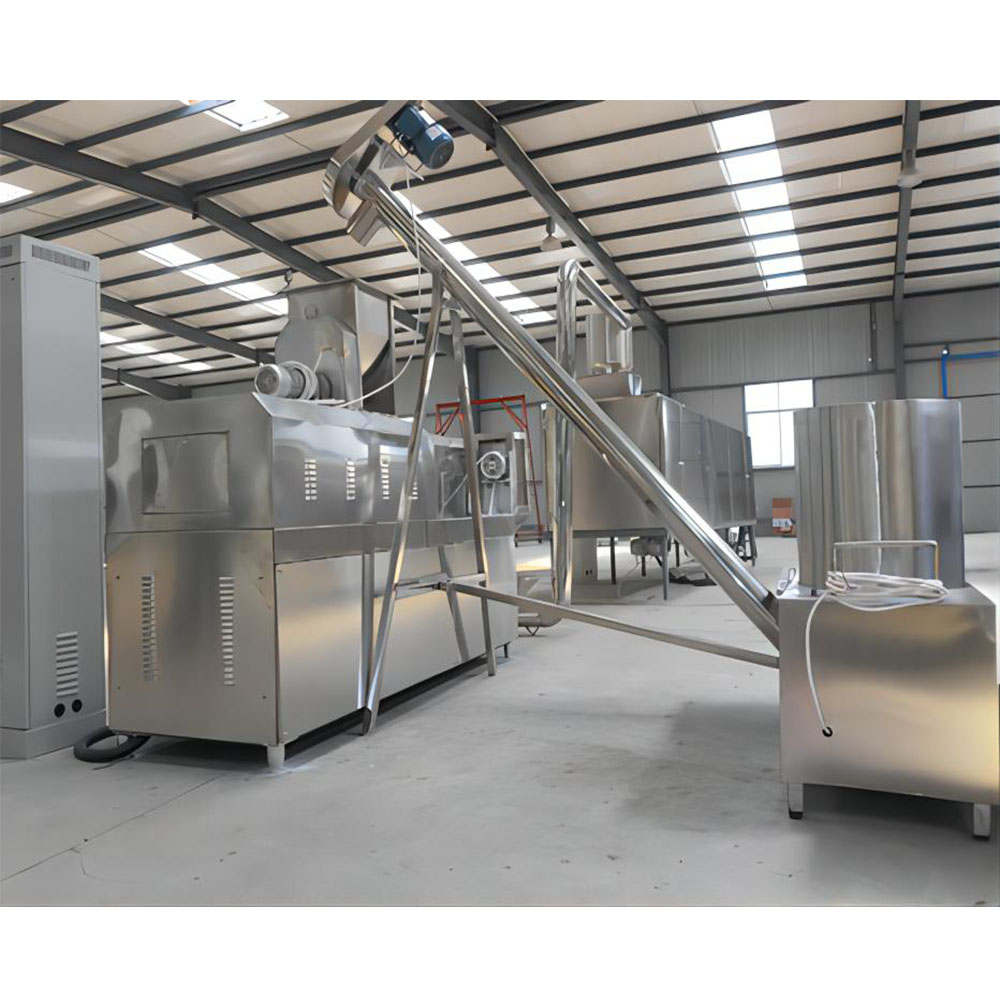
What Is a Complete Nut Butter Production Line: From Peanut to Almond?
The global nut butter market has evolved far beyond traditional peanut butter. Today’s food processors must handle peanuts, almonds, cashews, hazelnuts, and macadamias within a single facility, often switching between SKUs on the same shift. For Esper Foodtech customers exporting to North America, Europe, and the Middle East, this means investing in a flexible nut butter production line that delivers consistent particle size, stable emulsion, and FDA-compliant hygiene from raw intake to filled jar. This article walks through the full process flow, equipment selection, and compliance considerations for a modern nut butter plant.
- Batch continuity matters: Roasting, blanching, and grinding must be synchronized to avoid re-warming cooled nuts, which degrades oil stability.
- Particle size under 25 microns is the threshold for premium mouthfeel in almond and cashew butter.
- Blanching (ALP) is optional for peanuts but mandatory for export-grade almond butter to remove skins and avoid bitter astringency.
- FDA 21 CFR Part 117 (FSMA Preventive Controls) governs every food contact surface, requiring 304 or 316 stainless steel with welded seams.
- Colloid mill gap (PPG) determines final texture — adjustable from coarse crunchy (50µm) to ultra-smooth (15µm).
- Nitrogen flushing at the filler head extends shelf life from 12 to 24 months by reducing headspace oxygen below 2%.
Why Does Nut Butter Demand Reshapes Processing Lines?
Nut butter is no longer a commodity spread. Premium almond butter retails at four to seven times the price of conventional peanut butter, while single-origin cashew butter commands even higher margins in European specialty channels. For Chinese manufacturers such as Esper Foodtech’s export partners, this creates a clear opportunity: a single nut butter production line that can switch between peanut, almond, and cashew SKUs captures three revenue tiers with one capital outlay.
However, this flexibility is not free. Peanuts roast at 160–180°C for 20–40 minutes; almonds require gentler profiles (130–150°C) to avoid oil separation; cashews are too soft for abrasive milling and need a two-stage grind. A line designed only for peanuts will burn almonds and cream cashews into an oily paste. The line must be specified from the outset for multi-nut duty, with adjustable roasting zones, interchangeable blanching drums, and a colloid mill that accepts multiple gap settings.
Export compliance adds another layer. The U.S. FDA, EU DG SANTE, and Saudi SFDA each audit foreign suppliers under FSMA, HACCP, and GSO standards respectively. A line built for domestic peanut butter will typically fail all three audits on grounds of weld quality, traceability, and cleaning access. The design choices outlined in this article address all three regimes simultaneously.
Process Flow: Eight Stages From Sack to Jar
A complete nut butter production line breaks down into eight discrete unit operations, each governed by specific equipment and quality checkpoints. The table below maps every stage to its equipment, residence time, and critical control point.
| Stage | Equipment (Esper Model) | Residence Time | Critical Control Point |
|---|---|---|---|
| 1. Raw intake & cleaning | Vibrator sieve + de-stoner | 5 min | Foreign material < 0.1% |
| 2. Roasting | NRM-800 continuous drum roaster | 20–40 min | Moisture 1.5–2.0%, color L* 38–42 |
| 3. Cooling | Forced-air cooling tunnel | 8–12 min | Product temp < 40°C |
| 4. Blanching / skin removal | ALP-600 hot-water blancher | 3–6 min | Skin removal > 98% |
| 5. Coarse grinding | Knife-disc pre-mill | 2–4 min | Particle size 200–400 µm |
| 6. Fine grinding | PPG-400 colloid mill | 3–8 min recirculation | Particle size 15–25 µm |
| 7. Degas & stabilize | Vacuum tank + stabilizer mixer | 10–15 min | Air content < 3% |
| 8. Filling & capping | Piston filler + N2 flush + capper | Continuous | Fill weight ±1%, O₂ < 2% |
Material handling between stages is where many plants lose throughput. A common pitfall is routing cooled nuts through ambient-temperature screw conveyors that pick up 4–6% moisture condensation before reaching the grinder. Esper Foodtech recommends fully enclosed pneumatic transport with conditioned (dehumidified, 35% RH) air between the cooler and the grinder inlet — a small detail that adds six months of shelf life.
Roasting Mastery: NRM Series For Uniform Flavor Development
Roasting is the single most influential step in a nut butter line. It drives Maillard browning, reduces moisture to the 1.5–2.0% window required for stable emulsion, and deactivates enzymes that would otherwise oxidize nut oils within weeks. The Esper NRM-800 continuous drum roaster is engineered for this exact purpose, with five independently controlled heating zones and a counter-current hot air design that delivers roast uniformity within ±2°C across the drum cross-section.
Each nut species demands a different roast profile. The table below summarizes recommended settings that Esper engineers have validated across more than 40 commissioned lines.
| Nut Type | Drum Temp | Time | Final Moisture | Target L* Color |
|---|---|---|---|---|
| Peanut (Runner) | 170°C | 25 min | 1.8% | 40 |
| Almond (California Nonpareil) | 140°C | 30 min | 1.6% | 45 |
| Cashew (W320) | 130°C | 35 min | 2.0% | 48 |
| Hazelnut (Tonda Gentile) | 165°C | 22 min | 1.5% | 35 |
For export lines, the NRM-800 includes a data-logging module that records zone temperatures, drum speed, and product discharge temperature every 30 seconds, generating the FSMA-required roast verification records automatically. Operators do not need to fill paper logs by hand, eliminating the most common audit finding.
Blanching (ALP) And Skin Removal For Premium Butter
Domestic peanut butter lines often skip blanching, leaving skins in for color and fiber. Export-grade almond and cashew butter cannot. Skins carry tannins and astringent compounds that, when milled at high shear, produce a bitter, gritty product that loses repeat customers. The Esper ALP-600 hot-water blancher addresses this by passing nuts through a 92–96°C water bath for 3–6 minutes, softening the pellicle so the subsequent rubber-roller peeler strips it cleanly.
For customers who want to avoid wet processing, a dry blanching alternative uses infrared heating to crack the skin without water. This saves energy and wastewater treatment but achieves only 92–95% skin removal versus the 98–99% benchmark of wet blanching. The choice often comes down to end-market: U.S. mass-market almond butter typically uses dry blanching; European premium brands almost universally insist on wet blanching.
Operators who skip the cooling step between blanching and grinding often discover oil separation in the finished jar within four weeks. A 12°C product entering the colloid mill will absorb friction heat and exit above 85°C — the threshold at which nut oils begin to oxidize. Always insert a cooling tunnel between ALP and PPG stages.
Grinding Technology: PPG Colloid Mill Engineering
The colloid mill is the heart of any nut butter production line. Esper Foodtech’s PPG-400 uses a high-shear rotor-stator design with an adjustable gap between 0.05 mm and 1.0 mm. For peanut butter, the typical setting is 0.15 mm for smooth and 0.4 mm for crunchy. Almond butter requires 0.10 mm to break the cellular structure of the nut and release enough oil for a pourable consistency. Cashew butter, with its softer fat crystal matrix, needs a two-pass grind: first at 0.30 mm to fracture, then at 0.10 mm to refine.
Throughput on the PPG-400 reaches 400 kg per hour of finished butter when fed with pre-ground coarse paste. The mill housing is jacketed for chilled-water circulation, holding product temperature below 75°C even during continuous operation. This thermal control is non-negotiable: temperatures above 90°C cause the natural nut emulsifier (phospholipids) to denature, and the resulting butter will separate within weeks.
For manufacturers targeting the U.S. “natural” segment (no palm oil, no hydrogenation), the colloid mill must work harder. Without stabilizers to bind free oil, the butter relies entirely on mechanical emulsification. A recirculation loop that passes the product through the mill three to five times before filling is the proven solution, achieving stability of six to nine months without oil separation at ambient storage.
Filling, Sealing, and Shelf Life Extension
Filling is where many otherwise excellent nut butters lose shelf life. The product arrives at the filler at 60–70°C, holds dissolved air, and is pumped into jars that have been stored at ambient humidity. Each of these factors shortens shelf life. The Esper-recommended filling cell addresses all three: a mass-flow piston filler with a heated hopper (45°C) maintains viscosity; a vacuum pre-fill removes 90% of headspace air; and a nitrogen flush at the filler nozzle reduces residual oxygen to below 2% before capping.
The payoff is substantial. With proper filling protocol, peanut butter shelf life extends from 12 to 18 months, almond butter from 9 to 15 months, and cashew butter from 6 to 12 months. This extension is what makes export viable: a container shipped from China to the U.S. West Coast spends 18–24 days in transit, and another 30–60 days in distribution before reaching retail shelves. Without the additional shelf-life margin, the product would arrive at retail with only weeks of remaining freshness.
Capping torque is another under-appreciated variable. The induction seal liner requires 14–18 inch-pounds of torque to bond correctly to the jar rim. Below 12 inch-pounds, the seal leaks; above 22 inch-pounds, the cap distorts and the tamper-evident band breaks prematurely. Every Esper filling line includes an integrated torque monitor that rejects out-of-spec caps inline, ensuring 100% seal integrity.
FDA, FSMA, and Export Compliance Engineering
Compliance is not an afterthought; it must be designed into the line from the first weld. The U.S. Food Safety Modernization Act (FSMA), codified at 21 CFR Part 117, requires foreign suppliers to implement a written Preventive Controls Plan covering hazard analysis, process controls, sanitation controls, and recall procedures. Every piece of equipment in a nut butter production line exporting to the U.S. must support this plan through hygienic design, cleanability, and data capture.
Esper Foodtech engineers all export-grade lines to the following minimum standards:
- Material: Food contact surfaces in 304 or 316 stainless steel, with surface roughness Ra ≤ 0.8 µm to prevent biofilm adhesion.
- Welding: Full-penetration TIG welds ground flush, with no exposed threads or crevices on product-contact surfaces.
- Cleaning access: All pipelines sloped at ≥ 1% for drainage, with quick-release clamps every 1.5 m for CIP (clean-in-place) pigging.
- Traceability: Each batch tagged with lot code, raw material origin, roast parameters, and metal-detection result, retained for two years.
- Metal detection: Inline ferrous, non-ferrous, and stainless-steel detection at the filler infeed, with automatic reject diverter.
- Allergen control: Dedicated lines for tree nuts versus peanuts are recommended; if shared, validated cleaning protocols must precede every SKU change.
For EU export, the line must additionally satisfy EC 852/2004 on food hygiene and EC 178/2002 on traceability, including a one-step-forward, one-step-back record system. For Middle East export, GSO 1016 (Halal) and GSO 9 (Labeling) apply, with Arabic-language labeling and Halal slaughter certification for any additive that may contain animal-derived processing aids.
FAQ: Nut Butter Production Line
1. What is the minimum order quantity to justify a complete nut butter line?
A turnkey line from intake to filling, sized for 500 kg per hour of finished butter, typically pays back within 18–24 months at monthly output of 60 metric tons or more. Below that volume, contract manufacturing is usually more economical.
2. Can one line really process peanuts, almonds, and cashews?
Yes, with proper changeover protocols. The Esper multi-nut line allows SKU change in under 90 minutes, including a full CIP cycle between peanut (major allergen) and tree-nut runs. Without validated cleaning, cross-contamination will cause recalls.
3. Do I need to add stabilizers or hydrogenated oils?
Not necessarily. The U.S. “natural” segment explicitly forbids them, and many European retailers refuse stocked products containing them. Mechanical emulsification through a recirculating colloid mill achieves six to nine months of stability without additives.
4. How much floor space does a complete line require?
A 500 kg/h line, laid out linearly, requires approximately 320 m² including raw material staging, finished goods holding, and CIP skid. U-shaped or L-shaped configurations can compress this to 240 m² but reduce operator sightlines.
5. What is the typical lead time from order to commissioning?
For a turnkey Esper line, expect 14–18 weeks for manufacturing, 4–6 weeks for shipping and customs, and 3–4 weeks for installation and commissioning. Total project timeline is typically 22–28 weeks.
6. How do I validate the line for FDA before first shipment?
Conduct a scheduled process review with a Process Authority recognized by the FDA, complete a validation protocol covering roasting temperature distribution, metal detector performance, and CIP efficacy, and submit the resulting documentation to your U.S. importer for their Foreign Supplier Verification Program (FSVP) record.
Next Steps For Your Nut Butter Project
Whether you are entering the natural peanut butter category, expanding into premium almond butter, or building a multi-nut facility for export, the right nut butter production line configuration makes the difference between a profitable SKU and a recall risk. Esper Foodtech engineers have commissioned lines across Asia, the Middle East, and Africa, and we routinely tailor roast profiles, blanching sequences, and filler configurations to the specific nuts, jar formats, and target markets of each customer.
To discuss your project, request a line layout, or receive a quotation for the NRM roaster, ALP blancher, and PPG colloid mill combination that matches your throughput target, contact our application engineering team at [email protected]. We respond to all qualified project inquiries within one business day with a preliminary equipment list and budgetary pricing.
Learn more: cooking oil processing applications
Get a quote: [email protected]