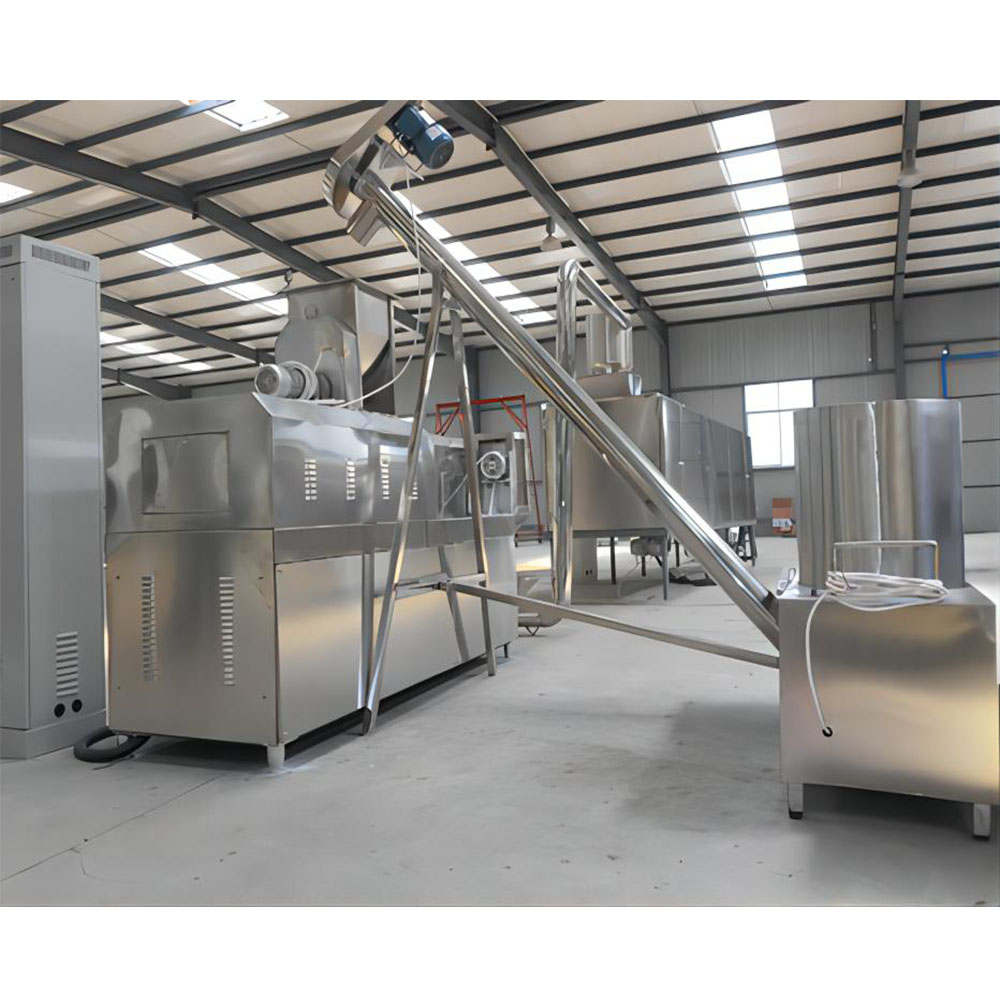
What Is a Complete Snack Food Manufacturing Line: Extrusion to Packaging?
The global snack food market has grown into a multi-billion-dollar industry, and at the heart of this expansion is the modern snack food manufacturing line. From crispy corn puffs and cheesy Cheetos to core-filled pillows and fried potato sticks, every product on supermarket shelves begins with a carefully engineered sequence of extrusion, frying or baking, flavoring, and packaging. For food processing companies and investors, understanding how a complete production line fits together — and what it costs to build — is the first step toward a profitable snack business.
This guide walks through a turnkey snack food manufacturing line built around Esper Foodtech machinery. We cover every critical stage, from raw material intake to sealed retail-ready packs, with capacity benchmarks, equipment matching, and realistic investment ranges. Whether you are producing 100 kg per hour for a regional brand or 1,000 kg per hour for export contracts, the configuration logic remains the same — only the scale changes.
- A complete snack line covers six stages: mixing, extrusion, drying/frying, flavoring, cooling, and packaging.
- Extruder type (single-screw vs. twin-screw) determines which snack categories you can produce.
- Capacity planning should match packaging throughput, not just extruder output.
- A 300–500 kg/h corn puff line typically requires $120,000–$280,000 in equipment investment.
- Fried snacks (Cheetos-style) need a continuous fryer, while baked/core-filled snacks need an extended drying tunnel.
- Flavoring drums and automated seasoning systems can double a product’s retail value at minimal cost.
- Esper Foodtech provides model codes such as EFP-CE100, EFP-CF150, and EFP-PK80 for modular line sizing.
Core Architecture of a Snack Food Manufacturing Line
A modern snack food manufacturing line is not a single machine but a synchronized chain. Each stage feeds the next at a controlled rate, and a bottleneck at any point reduces the entire line to that speed. The architecture below is typical for corn-based extruded snacks, but the same skeleton supports Cheetos, core-filled products, and fried sticks with minor substitutions.
The flow begins with a dosing mixer that blends corn grits or flour with water to a precise moisture content of 14–18%. This premix enters the extruder hopper, where rotating screws cook the starch under high temperature and pressure. The gelatinized dough is forced through a die, expands as it hits ambient air, and is cut into the desired shape by a rotating knife. From there, the product passes through a dryer or fryer to set texture and reduce moisture, then into a flavoring drum where oil and seasoning are applied. After cooling on an open conveyor, the snacks enter the packaging machine, which forms, fills, and seals them into nitrogen-flushed bags.
Esper Foodtech engineers each stage to match the rated capacity of the previous one. A common mistake among first-time buyers is oversizing the extruder while undersizing the packaging machine — the result is a line that produces 500 kg per hour but can only pack 300 kg per hour, with the surplus accumulating in buffer silos and going stale. A balanced line uses a packaging machine rated 10–15% above the extruder’s peak output to absorb surges.
Extrusion Technology: The Heart of Snack Production
Extrusion is the single most important stage in any snack food manufacturing line. The choice of extruder defines what products you can make, what textures you can achieve, and how much raw material flexibility you have. Esper Foodtech offers two main extruder families: single-screw for straightforward corn puffs and twin-screw for complex formulations including core-filled snacks, fortified products, and protein-enriched blends.
The EFP-CE100 single-screw extruder is the workhorse of corn puff production. With a 100 kg/h output and a 22 kW main motor, it handles corn grits, rice flour, and wheat flour with minimal adjustments. The screw design is optimized for direct-expanded snacks — curls, balls, wheels, and sticks — and the diehead can be swapped in under 15 minutes to change shapes. For producers targeting the entry-level corn puff market, this model offers the lowest cost per kilogram of output.
For more demanding products, the EFP-TW200 twin-screw extruder is the answer. Twin-screw designs provide better mixing, self-wiping action, and precise control over residence time. This makes them suitable for core-filled snacks (where a filling pump injects chocolate or cream into the center of an extruded tube), textured vegetable protein, and breakfast cereals. The EFP-TW200 runs at 200–250 kg/h and accepts a co-extrusion diehead for filled products. The trade-off is higher cost — roughly 2.5 times the price of an equivalent single-screw unit — and more complex maintenance.
| Model | Type | Capacity (kg/h) | Power (kW) | Best For |
|---|---|---|---|---|
| EFP-CE100 | Single-screw | 100–120 | 22 | Corn puffs, rice crisps |
| EFP-CE200 | Single-screw | 200–250 | 37 | Corn puffs, fried sticks |
| EFP-TW200 | Twin-screw | 200–250 | 45 | Core-filled, fortified snacks |
| EFP-TW500 | Twin-screw | 450–550 | 90 | Industrial-scale, exports |
Drying, Frying, and Cooking: Setting the Texture
After extrusion, the product is still soft and contains too much moisture for shelf-stable packaging. The next stage in the snack food manufacturing line reduces moisture and develops the crisp texture consumers expect. Two technologies handle this: dryers for baked snacks and fryers for fried snacks.
For corn puffs and core-filled products, a multi-layer dryer is used. Esper Foodtech’s EFP-DY120 is a five-layer gas-heated dryer with a 120 kg/h capacity. Each layer’s temperature and belt speed can be adjusted independently, allowing the moisture to be drawn down gradually from 18% to under 4%. This gradual drying prevents case hardening — a defect where the outside crisps but the inside stays chewy. The total drying time for corn puffs is typically 15–25 minutes at 140–180°C.
Fried snacks like Cheetos and fried corn sticks require a continuous fryer instead. The EFP-CF150 continuous fryer uses a mesh belt submerged in hot oil at 170–190°C. Frying time is short — 30 to 90 seconds — and the rapid dehydration creates the characteristic crunchy texture and golden color. Oil type matters: palm oil is the industry standard for stability and shelf life, but sunflower oil appeals to health-conscious markets. Continuous filtration removes crumbs and carbonized particles, extending oil life from 8 hours to 36–48 hours.
Choosing between drying and frying is a product decision, not a technology decision. Corn puffs can be dried or fried — the dried version is lower fat and longer lasting; the fried version is crunchier and more indulgent. Build your line around your consumer, not around the machine.
Flavoring and Seasoning: Where Margin Is Made
Seasoning is the most profitable stage in a snack food manufacturing line. A naked corn puff costs roughly $0.40 per kilogram to produce; the same puff with cheese seasoning sells for $4–6 per kilogram at wholesale. The flavoring system is therefore one of the highest-ROI investments in the entire line.
The standard configuration is a two-drum system. The first drum, an oil applicator, sprays a thin layer of vegetable oil onto the snack as it tumbles. This oil acts as an adhesive. The second drum, the seasoning drum, dusts the oiled snack with powdered flavoring — cheese, barbecue, sour cream and onion, chili, or any custom blend. Esper Foodtech’s EFP-FL80 flavoring system handles both stages in a compact footprint and can apply 4–8% seasoning by weight with a uniformity of ±0.5%.
For premium products, an electrostatic coating system can be added. Electrostatic applicators charge the seasoning particles, which are then attracted to the snack surface. This delivers more even coating with 30% less powder usage — a significant saving at scale. The EFP-FL80E model includes this feature and is recommended for plants running multiple SKUs with frequent changeovers.
- Cheese seasoning: 6–8% application rate, requires oil base.
- Spicy/chili blends: 4–6% application rate, optional oil.
- Sweet coatings: 10–15% sugar-based powders, applied warm.
- Chocolate coating: requires enrober, not a seasoning drum.
Cooling, Conveying, and Buffering
Once seasoned, snacks need to cool before packaging. Bagging warm snacks causes condensation inside the sealed pouch, which softens the product and shortens shelf life from 9 months to under 3 months. A cooling conveyor — typically 3 to 6 meters of open mesh belt with forced ambient air — drops the product temperature to within 5°C of room temperature before it reaches the packaging hopper.
The EFP-CL60 cooling conveyor uses three centrifugal fans pulling air through the belt bed. For high-humidity environments, an optional dehumidifier module keeps the cooling air dry. Between the cooling conveyor and the packaging machine, a vibrating or belt buffer can hold 50–150 kg of product. This buffer is critical: it allows the packaging machine to be stopped briefly for film roll changes or bag-size adjustments without halting the entire line upstream.
Esper Foodtech engineers pay particular attention to product transfer points. Snacks are fragile, and any drop greater than 30 cm between conveyors will create fines and broken pieces. Gentle transition chutes with rounded edges and food-grade plastic deflectors keep whole-piece yield above 95%.
Packaging: The Final Critical Stage
Packaging is where the snack food manufacturing line meets the consumer. A poorly chosen packaging machine can ruin an otherwise excellent product line — under-filled bags trigger customer complaints, over-filled bags give away product, and leaky seals cause stale returns. The right packaging machine matches the line’s throughput, handles the product gently, and produces consistently sealed bags.
For most snack lines, a vertical form-fill-seal (VFFS) machine is the standard. Esper Foodtech’s EFP-PK80 is an 8-lane VFFS machine rated at 80 bags per minute for pillow-type bags from 30 to 500 grams. It includes a multi-head weigher with 10 weighing heads, a nitrogen flush system for extended shelf life, and a servo-driven film pull for precise bag length control. Sealing temperature is PID-controlled on both the horizontal and vertical jaws, ensuring consistent seals even when film thickness varies.
For plants running multiple SKUs at high volume, the EFP-PK160 doubles the speed to 160 bags per minute with two servo-driven film pulls and a 14-head weigher. Both models support nitrogen flushing to achieve residual oxygen levels below 2%, which extends shelf life from 4 months to 9–12 months for fried snacks.
| Packaging Model | Speed (bpm) | Bag Range | Best Match |
|---|---|---|---|
| EFP-PK40 | 40 | 30–250 g | Entry-level, single SKU |
| EFP-PK80 | 80 | 30–500 g | Mid-size, multi-SKU |
| EFP-PK160 | 160 | 50–1000 g | Industrial, export contracts |
Capacity Sizing and Total Investment Analysis
Sizing a snack food manufacturing line correctly is the single biggest financial decision a plant owner makes. Undersize, and you cannot meet demand during peak seasons. Oversize, and your fixed costs — depreciation, electricity, labor — eat into margins during slow periods. The sweet spot for most new entrants is 300–500 kg per hour, which produces 2,400–4,000 kg per day across an 8-hour shift. This is enough to supply regional distribution and build retail traction without committing to export-scale volumes.
Below is a realistic investment breakdown for a 300 kg/h corn puff line, Esper Foodtech configuration. Prices reflect typical factory-direct pricing and include installation, commissioning, and operator training.
| Stage | Model | Indicative Cost (USD) |
|---|---|---|
| Mixer and dosing | EFP-MX50 | $6,000–$9,000 |
| Extruder (single-screw) | EFP-CE200 | $32,000–$45,000 |
| Continuous dryer | EFP-DY120 | $22,000–$32,000 |
| Flavoring system | EFP-FL80 | $9,000–$14,000 |
| Cooling conveyor | EFP-CL60 | $4,500–$7,000 |
| VFFS packaging machine | EFP-PK80 | $28,000–$42,000 |
| Conveyors, piping, electrical | — | $18,000–$30,000 |
| Total (300 kg/h) | — | $119,500–$179,000 |
For a fried snack line (Cheetos-style), substitute the dryer with the EFP-CF150 continuous fryer ($28,000–$40,000) and add an oil filtration system ($8,000–$12,000). The total typically lands at $135,000–$210,000 for the same 300 kg/h capacity. A twin-screw core-filled line is the most expensive configuration, often reaching $220,000–$320,000 due to the higher extruder cost and the addition of a filling pump and co-extrusion diehead.
Operating costs run roughly $0.35–$0.55 per kilogram of finished product, broken down into 40% raw material, 25% packaging film, 15% labor and overhead, 12% energy, and 8% flavoring. With a wholesale price of $3.50–$5.00 per kilogram for branded corn puffs, the gross margin sits between 65% and 75% — among the best in food processing. Payback periods of 14–22 months are common for well-run plants.
Frequently Asked Questions
1. What is the minimum space required for a complete snack food manufacturing line?
A 300 kg/h line typically requires 250–350 square meters of production floor, plus 100–150 square meters for raw material storage and finished goods warehouse. Ceiling height should be at least 4 meters to accommodate the multi-layer dryer. Allow 1.5 meters of clearance on all sides of each machine for cleaning, maintenance, and emergency access.
2. Can one line produce multiple snack types?
Yes, with limitations. A single-screw line with a dryer can produce corn puffs, rice crisps, and wheat sticks by changing the diehead and formulation. Adding a continuous fryer extends the range to fried snacks. However, twin-screw extruders are required for core-filled and protein-fortified products. Plan for 30–90 minutes of changeover time between SKUs.
3. How many operators does a typical snack line require?
A 300–500 kg/h Esper Foodtech line typically runs with three operators per shift: one on the extruder, one on the dryer or fryer, and one on the packaging machine. A shift supervisor oversees all three. Twin-screw lines with co-extrusion may require a fourth operator for the filling system. Automation options — automatic batch weighing, PLC-controlled seasoning dosing, and packaging auto-splicing — can reduce operator count to two for highly automated plants.
4. What is the typical shelf life of packaged extruded snacks?
With nitrogen flushing and high-barrier film ( metallized PET/PE), corn puffs and Cheetos-style snacks achieve 9–12 months of shelf life at ambient storage. Core-filled snacks typically reach 6–9 months due to moisture migration from the filling. Without nitrogen flush, expect 3–4 months maximum. Fried snacks require antioxidant in the oil or oxygen absorbers in the bag to prevent rancidity over long storage.
5. How long does installation and commissioning take?
For a 300 kg/h line, Esper Foodtech typically completes installation in 3–4 weeks, including equipment placement, electrical and pneumatic connections, and integration with the plant’s compressed air and steam supply. Commissioning and recipe development take another 1–2 weeks. Operator training runs concurrently and includes 40 hours of hands-on instruction per shift. Plan for 6–8 weeks total from delivery to first commercial production.
6. What raw materials can the extruder handle?
Corn grits (the most common), corn flour, rice flour, wheat flour, potato starch, tapioca starch, and oat flour are all supported on Esper Foodtech extruders. Twin-screw models can additionally handle high-fat formulations (up to 12%), high-sugar recipes, and protein blends above 20% protein content. For unconventional ingredients — lentil flour, chickpea, insect protein — pilot trials are recommended before committing to a full-line purchase.
Partnering with Esper Foodtech on Your Snack Line
A snack food manufacturing line is a multi-year investment, and the partner you choose matters as much as the machines you buy. Esper Foodtech has delivered complete extrusion-to-packaging lines to producers across more than 40 countries, ranging from 100 kg/h pilot lines for startup brands to 1,000 kg/h industrial systems supplying national retail chains. Every project begins with a raw material audit, a product brief, and a capacity plan — not a catalog page.
Our engineers work with you to size each machine to your target output, recipe, and budget. We supply turnkey installations including commissioning, training, and one year of remote support. Spare parts inventory is held in regional warehouses for 48-hour dispatch, and recipe libraries are continuously updated as new formulations and die designs are validated.
Whether you are launching your first corn puff brand, expanding from baked snacks into fried Cheetos-style products, or upgrading an aging line to meet modern retail standards, Esper Foodtech can configure a system that fits your factory, your market, and your balance sheet. Reach out to discuss your product, capacity target, and timeline.
Ready to build your snack food manufacturing line? Contact Esper Foodtech at [email protected] for a free consultation, line layout proposal, and detailed quotation tailored to your products and capacity goals.
Learn more: cooking oil processing applications
Get a quote: [email protected]