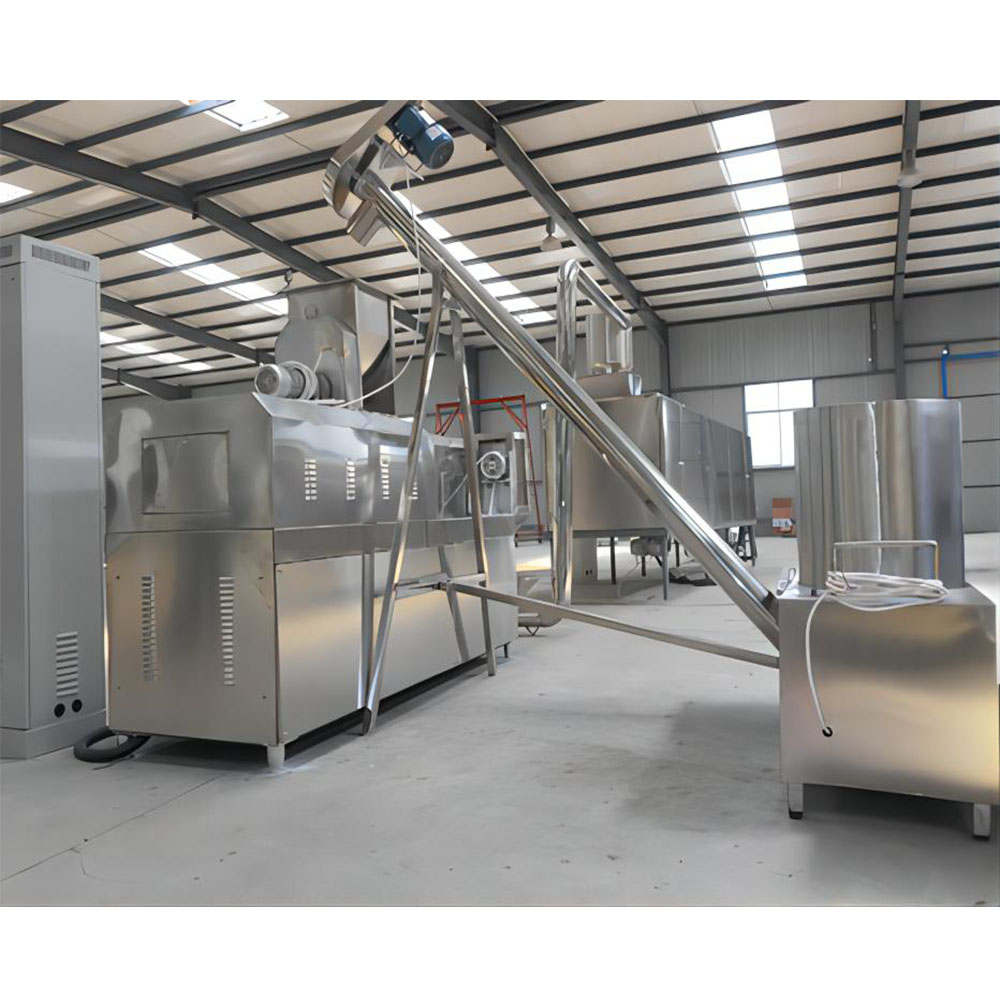
Peanut Butter Production Line: From Roaster to Colloid Mill (2026 Buyer Guide)
Peanut butter is one of the most profitable spreads in the global food market — USD 6.8 billion annually, growing 6.1% per year. For processors in Africa (Nigeria, Senegal, Sudan), Southeast Asia (Indonesia, Philippines), and Latin America (Argentina, Brazil), a peanut butter line converts locally-grown peanuts into a product worth 3–5× the raw material cost. This guide explains the line, the cost, and the strategic decisions that separate profitable operations from marginal ones.
Key takeaways:
- A 1 ton/day line costs USD 35,000–55,000 FOB China and produces 250,000 jars/year (350g each)
- The colloid mill is the heart of the line — buy a model with 50-micron final particle size for “smooth” texture
- Smooth, crunchy, and natural peanut butter require different finishing stages — choose equipment that can produce all three
- Private label manufacturing for supermarket chains generates 2.5× the margin of brand-name retail
- African processors using local peanuts + Chinese machinery achieve 38–55% gross margins (vs 18–24% for US/EU competitors)
- Mycotoxin (aflatoxin) control is the #1 reason plants fail FDA inspection — sort + lab test every batch
Why Does Peanut Butter Processing Is Booming in 2026?
Three trends drive the 2026 peanut butter market:
- Plant-based protein demand: Peanut butter has 25g protein per 100g — 3× the protein density of egg. The plant-protein trend has pushed US per-capita consumption from 1.8 kg/year (2018) to 2.7 kg/year (2025).
- African value addition: Historically, African countries exported raw peanuts at USD 800–1,200/ton. Processed into peanut butter, the same peanuts sell for USD 3,200–4,500/ton equivalent — a 4× value uplift.
- Private label expansion: Walmart (Great Value), Costco (Kirkland), Tesco, and Carrefour all expanded private-label peanut butter in 2024–2025. Each chain needs 2–4 contract manufacturers per region.
The 7-Stage Peanut Butter Production Line
A turnkey line integrates:
#### Stage 1 — Roasting (RSP-001 / NRM-001)
Raw peanuts (8–10% moisture) enter a continuous drum roaster at 160–180°C for 20–40 minutes. Roasting develops flavor, inactivates enzymes (lipase), and reduces moisture to ≤2%. Critical: uneven roasting causes off-flavors and oxidative rancidity. Use RSP-001 with thermostatic control.
#### Stage 2 — Cooling
Hot peanuts (160°C) are force-air cooled to 35°C in 8–12 minutes. Cooling halts roasting (prevents over-roast bitterness) and hardens the nuts for cleaner peeling.
#### Stage 3 — Peeling (RPP-001 Roasted Peanut Peeler)
The RPP-001 uses soft roller friction to remove the red skin, achieving 98%+ peel rate with <2% split kernels. Skin is collected via vacuum for animal feed or pectin extraction.
#### Stage 4 — Quality Sort (PSM-001 Optical Sorter)
PSM-001 peanut sorting machine uses optical color + shape sorting to reject:
- Aflatoxin-contaminated kernels (yellow-green discoloration)
- Unpeeled kernels (still red)
- Moldy, shriveled, or insect-damaged kernels
Critical: This is the most important stage for food safety. Aflatoxin-contaminated peanuts can kill your export business. Every batch must also be lab-tested.
#### Stage 5 — Grinding (Colloid Mill)
Peeled peanuts enter the colloid mill in two stages:
- First grind (hammer mill): coarse paste, 200–300 micron
- Second grind (colloid mill): fine paste, 30–50 micron — the “smooth” texture
For crunchy peanut butter, add 8–12% chopped peanuts back into the smooth paste. For natural, skip stabilizers and oil separation will occur (label “stir before use”).
#### Stage 6 — Mixing + Additives
In the mixing tank, add: hydrogenated vegetable oil (1–2% as stabilizer, prevents oil separation), sugar (3–7%), salt (1%), mono/diglycerides (0.5%), vitamins (optional). Heat 50–60°C for proper emulsion.
#### Stage 7 — Filling + Capping + Labeling
Peanut butter at 50°C is liquid — fills easily into glass or PET jars. The filling machine (PSF-001) handles 350g, 500g, 1kg jars at 1,000–4,000 jars/h. Capping (SCC-001), labeling (SLL-001), date coding, and carton packing complete the line.
Smooth vs. Crunchy vs Natural — Equipment Implications: Which Is Better?
| Product | Equipment Difference | Production Cost Premium | Retail Price Premium |
|---|---|---|---|
| Smooth (standard) | None (base case) | Base | Base |
| Crunchy | + Chopped peanut return system | +5% | +8–12% |
| Natural | Skip stabilizer, simpler recipe | -3% (fewer additives) | +20–30% (premium market) |
| Reduced-fat | + 30% fat-pressed peanuts + protein reclaim | +12% | +35–50% |
| Flavored (chocolate, honey, sriracha) | + Flavor mixing tank | +8% | +25–40% |
Strategy: Most plants start with smooth + crunchy (90% of market share) and add natural as a premium SKU once the line is running smoothly.
Cost Breakdown by Capacity
| Equipment | 1 ton/day | 5 ton/day | 20 ton/day |
|---|---|---|---|
| Drum roaster | USD 4,500 | USD 12,000 | USD 38,000 |
| Cooling conveyor | USD 1,500 | USD 4,000 | USD 12,000 |
| Peeler (RPP-001) | USD 3,500 | USD 8,500 | USD 18,000 |
| Optical sorter | USD 0 (manual) | USD 14,000 | USD 32,000 |
| Colloid mill (PPG-001) | USD 6,500 | USD 18,000 | USD 42,000 |
| Mixing tank | USD 2,500 | USD 5,500 | USD 12,000 |
| Filling line | USD 8,000 | USD 22,000 | USD 65,000 |
| Conveyors + frame | USD 4,000 | USD 10,000 | USD 28,000 |
| Total FOB China | USD 35,000–55,000 | USD 95,000–155,000 | USD 280,000–425,000 |
| Shipping + commissioning | +USD 5–8K | +USD 12–18K | +USD 30–45K |
Annual revenue (at USD 4/kg wholesale, 350g jar = USD 1.40):
- 1 t/day × 250 days = 250 tons = USD 1,000,000 revenue
- 5 t/day = USD 5,000,000 revenue
- 20 t/day = USD 20,000,000 revenue
Private Label Manufacturing — The Highest-Margin Play
Supermarket chains (Walmart, Tesco, Carrefour, Aldi, Lidl) buy peanut butter under their own private labels. To win these contracts:
- HACCP + ISO 22000 certification (we help with documentation)
- Batch traceability (lot codes per jar, traceable to peanut farm)
- Aflatoxin testing protocol (every batch, third-party lab)
- Capacity: Minimum 5 ton/day for most private-label contracts
- Packaging flexibility: Multiple jar sizes, private-label design capability
Private-label gross margins: 25–38% (vs 12–18% for brand-name retail).
Defect Prevention — 6 Common Quality Failures
| Defect | Cause | Prevention |
|---|---|---|
| Oil separation (in natural PB) | No stabilizer; gravity separates oil | Add 1–2% hydrogenated oil OR label “stir before use” |
| Aflatoxin contamination | Moldy peanuts in batch | Optical sort + lab test every batch (≤ 20 ppb limit) |
| Rancid flavor after 6 months | Oxidation of peanut oil | Nitrogen blanket in headspace; opaque packaging |
| Gritty texture | Colloid mill gap >50 micron | Reset mill gap weekly; target 30 micron |
| Color darkening | Maillard browning during storage | Cool rapidly post-roast; store ≤20°C |
| Crunchy bits too small | Chopper too fine | Use 4 mm screen for “crunchy” bits |
FAQ
Q1: Can I use raw peanuts without roasting?
No — raw peanut butter is a niche product with very short shelf life (2 weeks refrigerated) due to active enzymes. Roasting is mandatory for commercial peanut butter.
Q2: How long does peanut butter last?
Smooth peanut butter with stabilizers: 12 months ambient, 18 months refrigerated. Natural (no stabilizer): 6 months ambient, 12 months refrigerated.
Q3: Why does my peanut butter taste bitter?
Likely causes: (1) over-roasting >190°C, (2) burnt skins from peeler, (3) rancid peanuts in batch. Fix: calibrate roaster to 170°C, ensure peeler efficiency ≥ 97%, sort raw peanuts before processing.
Q4: Can I make almond butter on the same line?
Yes — same equipment with recalibration (almonds are harder, require 5°C higher roast). Clean thoroughly between batches.
Q5: What’s the smallest viable peanut butter operation?
A 200 kg/day tabletop line (small roaster + peeler + colloid mill + jar filler) costs USD 12,000–18,000 and produces 570 jars/day. Suitable for cooperative, farm-shop, or pilot operations.
Q6: How do I get HACCP certification for export?
Process: (1) develop HACCP plan with critical control points, (2) implement for 3–6 months with documentation, (3) engage a certifier (SGS, Bureau Veritas, Intertek) for audit, (4) receive certificate valid 3 years. We provide plan templates and audit preparation support.
CTA
To quote a peanut butter production line, send us:
- Target capacity (200 kg/day to 20 ton/day)
- Product mix (smooth / crunchy / natural / flavored)
- Raw peanut source (Africa / Argentina / India / China / USA)
- Packaging format (jar size, glass or PET)
- Target market (domestic / export)
- Building dimensions + power supply
Email [email protected] for a fixed-price quote within 24 hours.
Learn more: cooking oil processing applications
Get a quote: [email protected]