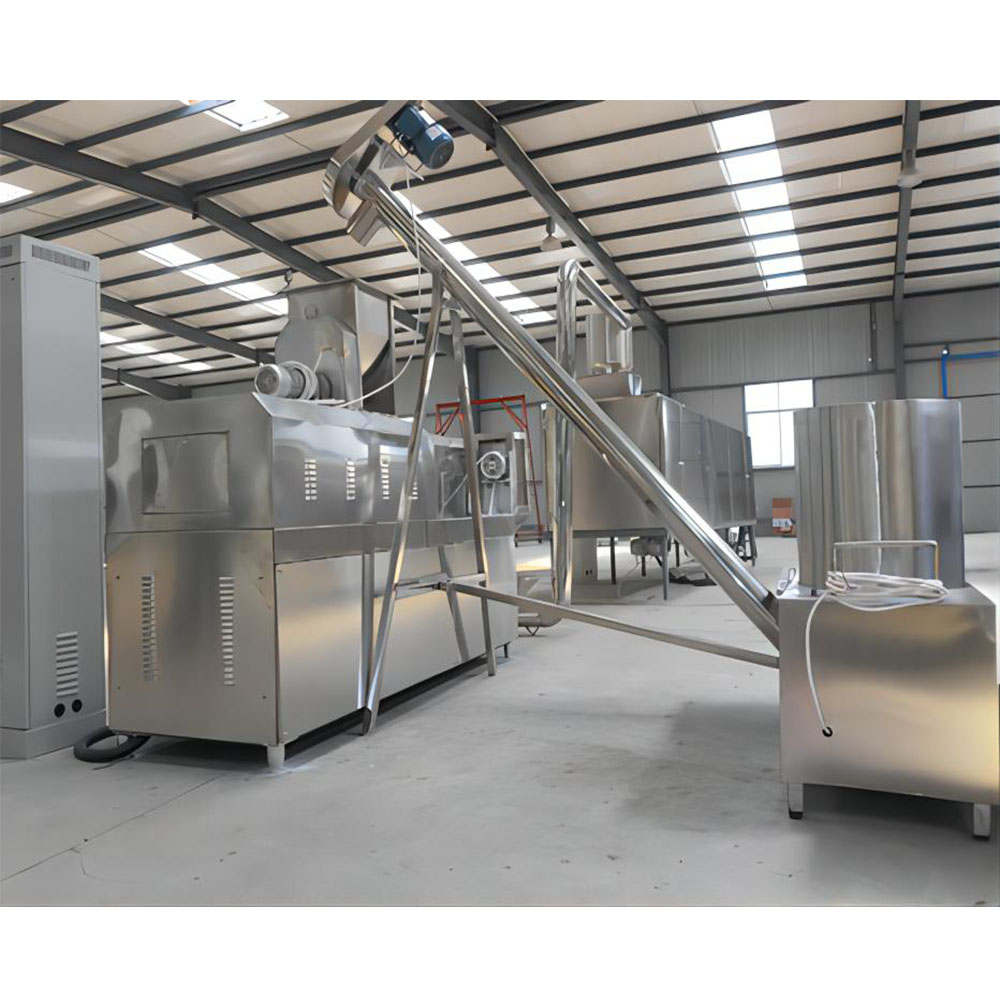
Snack Food Extruder Buyer Guide: Corn Puffs to Core-Filled
A snack food extruder is the forming and texturizing heart of any modern extruded snack line, converting cereal flours, starches, and other raw materials into puffed, fried, or baked products such as corn puffs, Cheetos-style curls, onion rings, and core-filled pillows. Choosing between a single-screw and a twin-screw extruder — and matching the machine to the die shapes, throughput, and downstream frying or baking equipment you actually need — is the most consequential buying decision for snack manufacturers in Africa and Southeast Asia. This guide walks buyers through the technical, operational, and commercial factors that determine total cost of ownership and product quality for extrusion lines serving local, regional, and export markets.
- Single-screw extruders suit high-volume, single-product corn puff and curl lines with stable raw material supply.
- Twin-screw extruders handle core-filled snacks, multi-ingredient recipes, frequent product changeovers, and tighter density control.
- Die and cutting head design directly determines final product shape, length consistency, and scrap rate.
- Capacity planning must account for raw material moisture, target bulk density, and ambient conditions typical of tropical climates.
- Frying line integration (continuous fryer, deoiler, seasoning drum) must be sized together with the extruder, not added as an afterthought.
- Total cost of ownership includes energy, wear parts, operator skill, and downtime — not just the equipment purchase price.
What Does a Snack Food Extruder Actually Do?
A snack food extruder is a thermomechanical cooking and forming machine. Cereal flour or grits — most commonly corn, wheat, rice, or potato-based starches — enter a barrel containing one or two rotating screws. The screws convey, compress, shear, and heat the material through a combination of friction, conducted barrel heat, and sometimes direct steam injection. By the time the cooked mass reaches the die at the barrel’s end, it is a hot, plasticized, gelatinized dough under high pressure. As this dough exits the die into atmospheric pressure, moisture flashes off as steam and the product expands — producing the cellular, crunchy structure consumers recognize as a puffed snack.
The cutting mechanism at the die face — typically a rotating knife assembly — slices the expanding extrudate into individual pieces. The shape of the die orifice determines the cross-section of the product (star, ring, wheel, curl, tube, alphabet, etc.), while the knife speed relative to extrusion velocity determines piece length. After cutting, the wet extrudate (typically 20 to 35 percent moisture post-die) moves to a dryer, fryer, or roaster for final texture development and moisture reduction to the 1 to 3 percent range required for shelf stability.
For core-filled snacks, the extruder barrel includes a co-axial injection tube that delivers a paste (peanut butter, chocolate, cheese, etc.) into the center of the tubular extrudate just before the die. The outer dough then forms a protective shell around the filling, producing the characteristic pillows and tubes popular in many African and Southeast Asian markets.
Single-Screw vs Twin-Screw Extruders
The single most important buying decision is screw configuration. The two architectures serve different production realities, and choosing the wrong one will constrain your business for the life of the equipment.
Single-Screw Snack Food Extruders use one rotating screw inside a grooved or smooth barrel. They are mechanically simpler, have fewer moving parts, and are typically 30 to 50 percent lower in capital cost than equivalent-capacity twin-screw machines. Their conveying action is efficient for low-moisture, free-flowing cereal grits (corn meal at 8 to 14 percent moisture), which makes them the conventional choice for high-volume corn puff, curl, and ball production. Limitations include reduced mixing capacity, less precise residence-time control, narrower formulation flexibility, and difficulty handling sticky or oily ingredients in the barrel. Frequent product changeovers are slower because screw configuration is more fixed.
Twin-Screw Snack Food Extruders use two intermeshing screws that rotate either co-rotating (most common in snacks) or counter-rotating. Their positive displacement action, self-wiping screw profile, and superior mixing make them well-suited to recipes containing multiple flours, starches, proteins, oils, and wet ingredients — including the doughs needed for core-filled snack shells. They offer tighter control over residence time, product density, and expansion ratio, which translates to more consistent piece weight and texture. They are also more tolerant of raw material variability, which matters in regions where flour particle size and moisture are inconsistent between suppliers. Trade-offs include higher capital cost, more complex maintenance, higher energy consumption per kilogram of throughput, and a steeper operator learning curve.
| Parameter | Single-Screw Extruder | Twin-Screw Extruder |
|---|---|---|
| Typical capacity (corn puffs) | 100 to 500 kg/h | 150 to 1,200 kg/h |
| Formulation flexibility | Limited; single-cereal recipes preferred | High; multi-ingredient, oily, sticky recipes |
| Product range | Corn puffs, curls, balls, simple shapes | Puffs, curls, core-filled, pellets, textured protein |
| Density control | Moderate | Tight (±3 to 5 percent) |
| Changeover time | Longer (fixed screw profile) | Shorter (modular screw elements) |
| Relative capital cost | Lower (baseline) | 30 to 50 percent higher |
| Operator skill required | Moderate | Higher (PLC tuning, recipe management) |
| Typical lifetime wear parts | Screw, barrel liners, die, cutters | Screw elements, barrel liners, die, cutters, gearbox |
Esper Foodtech Snack Food Extruder Models
Esper Foodtech (food-processing-machine.com) offers a range of snack food extruders designed for the capacity, recipe, and budget realities of manufacturers across Africa, Southeast Asia, the Middle East, and Latin America. The model codes below correspond to common configurations; buyers should confirm specifications against current production data at the time of inquiry.
BCH-001 Single-Screw Corn Puff Extruder: A workhorse single-screw machine for corn puff curls, balls, and simple two-dimensional shapes. Typical throughput ranges from 120 to 250 kg/h depending on die configuration and raw material. Well-suited to entry-level snack producers and contract manufacturers serving a single market segment. Lower installed power (typically 18 to 30 kW main drive) keeps operating costs modest for buyers in regions where electricity tariffs are high or supply is intermittent.
BCH-002 Twin-Screw Snack Extruder: A mid-capacity twin-screw machine covering 250 to 500 kg/h, capable of producing puffs, curls, onion rings, and the tubular shells used for core-filled snacks. The modular screw profile supports frequent recipe changeovers. This model is the typical choice for producers diversifying into multiple SKUs and value-added formats such as filled pillows and flavored tube snacks.
BCH-003 High-Capacity Twin-Screw Extruder: A larger twin-screw platform in the 600 to 1,200 kg/h range, designed for regional and export-oriented producers running extended shifts. Compatible with continuous frying lines, multi-stage dryers, and automated seasoning systems. The heavier barrel construction and higher-grade wear materials support longer run times between screw and barrel liner replacements.
BCH-004 Core-Filled Snack Extruder: A twin-screw configuration with integrated co-axial filling pump, specifically engineered for core-filled pillows and tubes. The filling head accepts a range of paste viscosities, from chocolate and peanut butter to soft cheese and savory bean pastes. Buyers producing for halal-certified or Kosher-certified markets should confirm filling pump material compatibility and cleanability.
BCH-005 Fry-Integrated Snack Line: A turnkey configuration combining BCH-002 or BCH-003 extruders with a continuous fryer, deoiler, cooling conveyor, and seasoning drum. Designed for producers of fried corn curls, Cheetos-style products, and fried pellets. Integrated lines are sized to match extruder throughput to fryer capacity, avoiding the bottlenecks that occur when components are sourced separately.
MDC-001 Pellet and Half-Product Extruder: A specialized configuration for producers of extruded pellets (fried later at point of sale or by a downstream partner). Lower expansion at the die produces a dense, glassy half-product that puffs when fried. Suitable for businesses supplying distributors or exporting shelf-stable pellets.
Specifications such as main drive power, screw diameter, barrel length-to-diameter ratio, and heating zones vary by model and build year. Buyers should request the current data sheet and confirm motor brand (Siemens, ABB, or equivalent), PLC make (Siemens, Mitsubishi, or equivalent), and material certifications (food-grade stainless steel contact surfaces, typically 304 or 316 grade) for their target export markets (verify for your market).
Sizing Your Snack Food Extruder for Real Capacity
Extruder nameplate capacity is usually quoted for corn meal at a reference moisture and a specific product density. Real-world throughput in your facility will depend on several factors that buyers often overlook during the quoting stage.
Raw Material Characteristics: Flour particle size, starch damage level, and incoming moisture all affect gelatinization behavior and expansion. In many African and Southeast Asian markets, corn meal may arrive with variable particle distributions and moisture content ranging from 10 to 16 percent. Buyers should request capacity data based on the local raw material specification, not a clean laboratory sample. Requesting a sample trial on your local flour is a reasonable step before final purchase.
Target Product Density: A light, highly expanded corn puff requires less dough per kilogram of finished product than a dense, low-expansion curl or pellet. The same extruder may produce 250 kg/h of dense curls but only 180 kg/h of highly expanded puffed balls. When comparing quotes, specify the exact target bulk density (in g/L) for each product you intend to manufacture.
Ambient Conditions: Tropical climates with high humidity and warm intake air affect barrel cooling efficiency and final product moisture. Extruders operating in 35°C, 80 percent relative humidity environments may require larger cooling water circuits or chilled water systems to maintain stable barrel temperatures. Buyers should confirm cooling water temperature and flow requirements against local utility availability.
Daily Operating Hours: A 250 kg/h extruder running 16 hours per day produces roughly 4 metric tons per day. The same machine running 22 hours per day produces about 5.5 metric tons per day. Capacity planning should be based on realistic shift patterns, scheduled maintenance windows, and clean-down time between flavor changeovers.
Die Shapes and Tooling Considerations
The die is the single most product-specific component on a snack food extruder. Its design determines cross-sectional geometry, surface texture, expansion behavior, and even flavor release in the finished product. Buyers should treat die selection as a strategic decision, not a consumable afterthought.
Standard Die Shapes: Common shapes include round, oval, star, wheel, ring (onion ring style), curl (Cheetos style), tube (for core-filled), square, alphabet letters, and 3D shapes such as cones and shells. Each shape requires a specific die insert and matching cutter configuration. Buyers producing multiple shapes should budget for a complete tooling kit at the time of machine purchase, as ordering individual dies later often incurs higher unit cost and longer lead times.
Die Material and Wear Life: Dies are typically manufactured from hardened stainless steel or tool steel. Higher-throughput extruders with abrasive formulations (such as those containing rice flour or mineral fortificants) consume dies faster than corn-only recipes. Expected die life can range from 500 to 5,000 hours depending on product and material. Buyers in markets with limited local die-grinding services should hold 2 to 3 spare die sets per shape to avoid extended downtime.
Cutter Assembly: The cutter assembly — rotating fly knives that slice the extrudate at the die face — has a major effect on piece length consistency and scrap. Dull or misaligned knives produce uneven cuts and fines that lower yield. Buyers should confirm cutter blade material (typically hardened tool steel or tungsten carbide tipped for premium configurations), the speed control mechanism (fixed speed, variable frequency drive, or servo), and the ease of blade replacement during operation.
Custom Die Development: Producers who want a unique product shape — a brand-specific animal, letter, or logo — require custom die engineering. Esper Foodtech and comparable manufacturers can develop custom dies against a CAD drawing or sample product. Lead times for custom dies typically run 4 to 8 weeks and may involve tooling charges. Buyers planning to differentiate on shape should engage die development early in the equipment specification process.
Frying Line Integration for Fried Snacks
Many corn puffs, curls, and pellets are finished by frying rather than baking. The extruder produces a dense, low-moisture half-product; the fryer rapidly puffs and crisps it in hot oil. Proper integration between extruder and fryer is essential and is one of the most common sources of capacity mismatch in buyer-assembled lines.
Throughput Matching: The fryer must accept the extruder’s output at steady state, with adequate dwell time (typically 20 to 60 seconds for snack half-products) at the target oil temperature (170 to 195°C). Undersized fryers force the extruder to slow down, lowering daily output. Oversized fryers waste energy and oil. Buyers should size the fryer at 110 to 120 percent of extruder peak output to absorb minor flow variations and warm-up transients.
Oil Type and Quality Management: Palm oil is the dominant frying medium in Africa and Southeast Asia due to cost and availability, but sunflower, soybean, and rice bran oils are also used. Oil quality directly affects product shelf life and flavor. The frying system should include continuous oil filtration to remove fines, an oil turnover schedule, and ideally a free fatty acid monitoring routine. Buyers should confirm that the fryer’s filtration system matches the crumb load generated by their specific product.
Deoiling and Cooling: After frying, excess surface oil must be removed — typically by centrifugal deoiler or air knife — to meet target oil content (often 20 to 32 percent for corn puffs and curls). The cooling conveyor stabilizes the product before seasoning. Inadequate cooling causes seasoning clumping and moisture migration in the packaging stage.
Seasoning Application: The seasoning drum applies powder coating (cheese, barbecue, sour cream and onion, chili, etc.) immediately after frying. Drum diameter, rotation speed, and spray oil flow rate determine coating uniformity. Buyers running multiple flavors per day should consider rapid-change seasoning drums to minimize downtime between flavor runs.
Energy, Water, and Utility Requirements
Snack food extruders are energy-intensive machines. Main drive motors, barrel heaters, cooling water pumps, and downstream dryers or fryers all draw significant power. Buyers must size electrical supply, compressed air, and cooling water infrastructure to match the equipment, not retrofit later.
Electrical Supply: Total installed power for a mid-range twin-screw line (extruder, dryer, fryer, seasoning) commonly runs from 120 to 250 kW. Buyers in regions with unstable grid supply should plan for backup generation capacity, typically diesel generators rated at 130 to 150 percent of connected load to absorb motor starts. Voltage (380V or 415V three-phase is standard; 440V or 460V also seen) and frequency (50 Hz is standard across Africa, Southeast Asia, and most of the Middle East) must match machine specifications exactly.
Compressed Air: Pneumatic actuators, material conveying systems, and some packaging equipment require compressed air at 6 to 8 bar with adequate dryer capacity to remove moisture. Buyers should confirm the extruder line’s total air consumption and size the compressor accordingly.
Cooling Water: Barrel cooling circuits typically require chilled or tempered water at 15 to 25°C with flows of 20 to 60 liters per minute depending on extruder size. In tropical climates, a dedicated chiller is often required; ambient cooling tower water may not provide sufficient cooling, especially during hot season operation.
Steam (if applicable): Some extruder configurations use direct steam injection for barrel heating. Steam demand at 6 to 10 bar must be matched to a boiler sized for the full line, not just the extruder.
Raw Material and Formulation Considerations for African and Southeast Asian Markets
Local raw material availability should drive equipment selection. Both regions offer specific opportunities and constraints that influence extruder choice and recipe design.
Africa: Corn (maize) is the dominant snack base across West, East, and Southern Africa. Cassava flour, sorghum, and increasingly rice flour are used in specialty snacks. Fortified snacks with added vitamins and minerals — often supported by government nutrition programs — require extruders tolerant of mineral premixes that accelerate die wear. Twin-screw configurations (such as BCH-002 or BCH-003) typically handle fortification recipes more reliably than single-screw machines.
Southeast Asia: Rice, tapioca, and corn are common snack bases, often combined with shrimp, fish, or vegetable powders for savory flavors. These multi-ingredient recipes benefit from twin-screw mixing capacity. Palm oil is widely available and inexpensive, supporting fried snack production. Halal certification is essential across the region’s Muslim-majority markets (Indonesia, Malaysia, Brunei) and influences equipment material selection and lubricant specifications (verify for your market).
Local Sourcing: Buyers should map local flour suppliers, evaluate particle size consistency, and consider whether a single-screw machine’s tolerance band matches local raw material variability. Where flour quality varies, the higher capital cost of a twin-screw extruder is often recovered through reduced scrap and fewer rejected batches.
Total Cost of Ownership Beyond the Purchase Price
The sticker price of a snack food extruder is only a fraction of total cost of ownership over a 7 to 12 year operating life. Buyers evaluating quotes should build a TCO model that captures the following items:
Energy Cost per Kilogram: Single-screw extruders typically consume 0.18 to 0.28 kWh per kilogram of finished corn puffs; twin-screw machines range from 0.22 to 0.40 kWh per kilogram depending on recipe complexity. At local electricity tariffs, this difference can amount to tens of thousands of dollars per year for a mid-capacity line.
Wear Parts and Spares: Screws, barrel liners, die inserts, cutter blades, seals, and bearings are consumable. Annual wear parts cost typically runs 3 to 7 percent of equipment purchase price for corn-based production and higher for abrasive or mineral-fortified recipes. Buyers should confirm spares pricing and lead time before purchase, and prioritize suppliers with regional spares depots or responsive air freight.
Operator Skill and Training: Twin-screw extruders require more skilled operators and process engineers than single-screw machines. Training time, recruitment cost, and turnover risk should be factored into the decision. Some buyers in regions with limited snack industry experience find that the simpler operation of single-screw machines matches their workforce for the first few years, with twin-screw upgrades planned for later expansion.
Downtime Cost: A 250 kg/h line down for 24 hours represents roughly 6 metric tons of lost output. Reliable start-up, fast changeover, and accessible maintenance features have direct financial value. Buyers should ask suppliers about mean time between failures, typical repair times, and remote diagnostic support availability across time zones.
Yield and Scrap: Twin-screw extruders typically deliver tighter piece-weight consistency and lower scrap rates (1 to 3 percent) compared with single-screw machines (3 to 7 percent) on multi-ingredient recipes. For high-volume producers, even a 2 percent yield improvement can pay back the twin-screw premium within 12 to 24 months.
Quality, Food Safety, and Certification
Extruded snacks for retail sale and export require compliance with food safety standards. Buyers serving export markets or seeking retail distribution should confirm equipment supports their target certifications.
Contact Surface Materials: Food contact surfaces should be food-grade stainless steel (typically AISI 304 for general use, AISI 316 for corrosive or high-salt recipes). Buyers should request material certificates and verify weld quality, surface finish (typically Ra ≤ 0.8 µm for food contact), and cleanability of dead spots in the barrel and die assembly.
HACCP and GMP Compatibility: The extruder line should be designed to support Hazard Analysis and Critical Control Points (HACCP) and Good Manufacturing Practices (GMP). Key design features include hygienic welds, accessible cleaning, no dead legs in piping, separation of raw and cooked product zones, and compatibility with clean-in-place (CIP) or rapid manual clean-down routines.
Certification Targets: Buyers targeting export to the European Union, Gulf states (SFDA), or regional African blocs may need CE marking, ISO 22000, FSSC 22000, or local equivalents. Buyers targeting halal markets need halal-compatible lubricants and material documentation (verify for your market). Kosher certification requires additional documentation for any product contact materials and lubricants.
Traceability and Process Control: PLC-controlled extruders with recipe management, batch logging, and critical parameter alarms (barrel temperature, screw speed, motor load, cutter speed) support traceability requirements. Buyers should confirm the PLC’s data logging capability, storage duration, and compatibility with their factory’s quality management system.
Installation, Commissioning, and Training
Equipment installation is a project in itself. Buyers should plan for site preparation, utility connections, commissioning time, and operator training before the machine ships.
Site Preparation: Floor loading, vibration isolation, ventilation, drainage, utility drops, and equipment clearance for maintenance must be specified before delivery. Buyers should request installation drawings and confirm floor flatness and load ratings.
Commissioning Time: Snack extrusion lines typically require 1 to 4 weeks of commissioning, including initial start-up, recipe tuning for each product, die and cutter adjustment, and integration with downstream equipment. Buyers should confirm whether commissioning is included in the purchase price and whether it covers multiple product recipes or only one.
Operator and Maintenance Training: Formal training — typically 5 to 15 days on site — should cover machine operation, recipe setup, cleaning, preventive maintenance, troubleshooting, and safety. Buyers should request training materials in a language their operators understand, and consider sending lead operators to the supplier’s facility for advanced training during commissioning.
Spare Parts Package: An initial spares package covering the first 12 to 24 months of operation should be negotiated at the time of purchase. This typically includes die sets, cutter blades, seals, filters, bearings, and wearing screws or barrel liners. Buyers should request a recommended spares list with pricing and lead times.
Frequently Asked Questions
Q: Can a single twin-screw extruder produce both corn puffs and core-filled snacks?
A: Yes, a twin-screw extruder such as the BCH-002 or BCH-004 can produce both formats with the appropriate screw configuration, die, and — for core-filled products — the co-axial filling pump attachment. Changeover between formats typically requires several hours, including screw reconfiguration, die swap, and cleaning. Buyers producing both formats regularly should confirm the supplier’s changeover procedure and training support.
Q: What is the typical payback period for a snack food extruder line in Africa or Southeast Asia?
A: Payback depends heavily on selling price, capacity utilization, raw material cost, and distribution reach. For well-managed lines serving growing domestic snack markets, payback periods of 18 to 36 months are commonly reported, though this varies widely by country and product category (verify for your market). Buyers should build a financial model using local selling prices, not regional averages, before committing to purchase.
Q: How important is the brand of electrical and control components?
A: Component brand affects long-term reliability, spare parts availability, and resale value. Recognized brands such as Siemens, ABB, Schneider, Mitsubishi, and Delta are widely supported across Africa and Southeast Asia. Lesser-known brands may offer lower initial cost but can complicate maintenance and repair, especially in regions with limited technical support. Buyers should request a component list at the quoting stage.
Q: What product shelf life can I expect from extruded snacks produced on these machines?
A: Properly fried or baked extruded snacks with final moisture below 3 percent, packaged in moisture-barrier films with nitrogen flush, typically achieve 6 to 12 months shelf life at ambient tropical storage conditions. Shelf life is determined more by packaging, oil quality, and moisture control than by the extruder brand. Buyers should coordinate extruder, dryer/fryer, and packaging specifications together (verify for your market).
Q: Can these extruders handle locally sourced corn meal with variable quality?
A: Twin-screw extruders are generally more tolerant of raw material variability than single-screw machines. However, all extruders benefit from consistent raw material. Buyers should consider pre-blending and sifting of local flour, and may benefit from a small hammer mill or sifter to standardize particle size before the extruder. Requesting a trial run on the buyer’s actual local flour is a reasonable step before final purchase.
Q: What is the difference between a fried snack line and a baked snack line, and which should I choose?
A: Fried snack lines (extruder plus fryer) produce the high-oil, highly crisp textures associated with corn curls and Cheetos-style products. Baked snack lines (extruder plus dryer or oven) produce lower-oil products with a different texture profile, often positioned as healthier alternatives. Choice depends on target market, consumer preference, oil cost, and positioning. Some buyers install both capabilities to serve multiple market segments.
Making the Purchase Decision
After evaluating capacity needs, recipe range, available utilities, raw material characteristics, and total cost of ownership, buyers should request formal quotations from two or three qualified suppliers, including detailed specifications, component lists, warranty terms, spares pricing, commissioning scope, and references from comparable installations in their region. Site visits to a reference customer — particularly one operating in a similar climate and raw material environment — can de-risk the decision substantially.
For manufacturers in Africa and Southeast Asia serving both domestic and regional export markets, the BCH-002 and BCH-004 twin-screw configurations often represent a strong balance of capacity, flexibility, and long-term return on investment, while the BCH-001 single-screw machine remains an excellent entry point for focused corn puff producers. The BCH-005 fry-integrated line offers a turnkey path for fried snack specialists who want guaranteed compatibility between extruder and fryer.
Whatever your product range, capacity target, or budget tier, the Esper Foodtech team can help you match the right snack food extruder configuration to your specific market and recipe. For detailed specifications, current pricing, lead times, and to arrange a technical consultation, contact [email protected].
Learn more: cooking oil processing applications
Get a quote: [email protected]