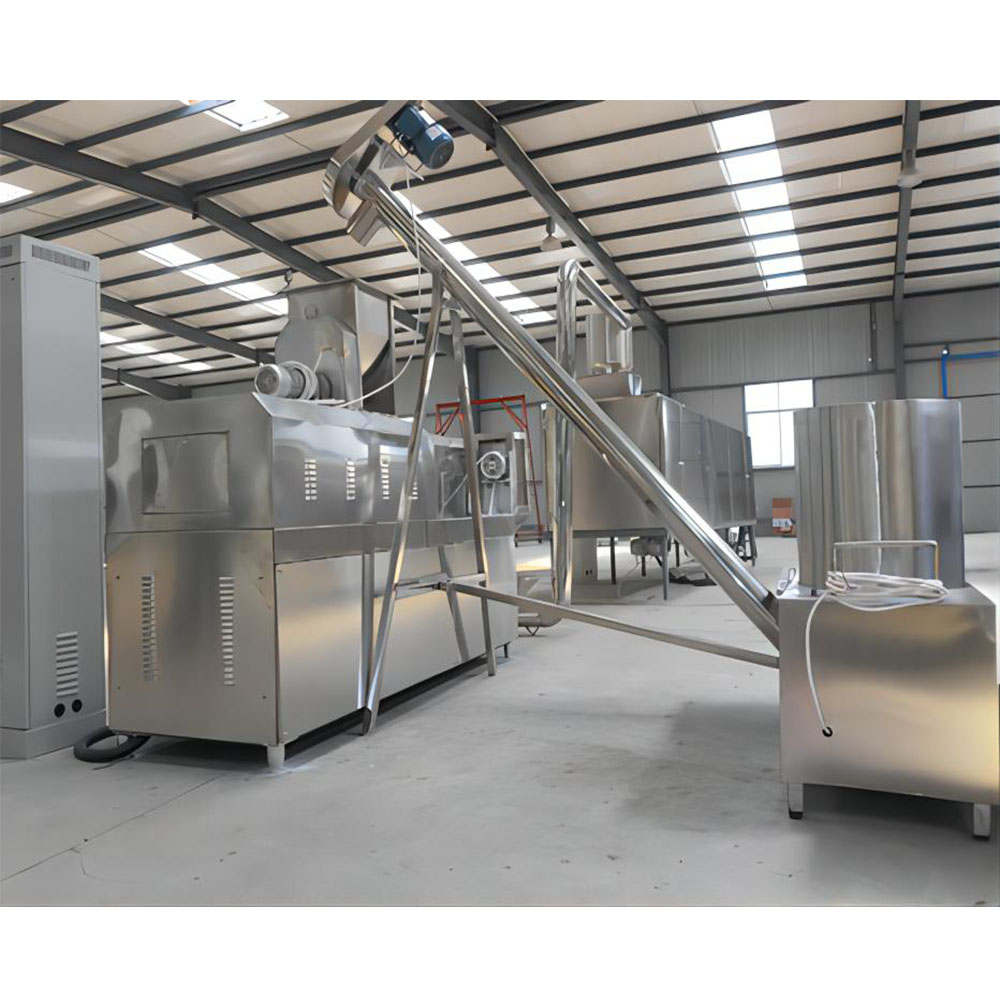
Almond Processing Line: Hulling to Blanching
A complete almond processing line takes raw in-shell field product through hulling, sizing, splitting, blanching or roasting, and into finished packaged kernels ready for ingredient, snack, or confectionery buyers. For processors in California’s Central Valley and Spain’s Mediterranean growing regions, the choice of almond processing equipment directly决定了 skin-removal yield, split accuracy, aflatoxin control, and ultimately the price a finished lot can command on export markets. This guide walks buyers through every stage of an integrated line, from receiving to packaging, with model references to the Esper Foodtech ALP-001 blanching peeler, PKS-001 splitter, and NRM-001 roaster.
The economics are significant: a 2-ton-per-hour line typically represents a mid-six-figure capital investment, and a one-percent improvement in whole-kernel recovery or a half-percent reduction in blanching losses can shift annual gross margin meaningfully. Selecting equipment matched to your raw material characteristics, target finished product, and local labor and utility conditions is therefore a decision that warrants careful technical evaluation rather than impulse purchasing from a single catalog.
- Key Takeaways:
- A modern almond line is modular: receiving, hulling, cleaning, sizing, conditioning, blanching or roasting, splitting, inspection, and packaging — each stage can be sourced separately or as a turnkey package.
- The ALP-001 blanching peeler is the heart of any kernel-skin removal step and is typically the most specification-sensitive machine in the line.
- The PKS-001 splitter handles natural-split separation and forced splitting of conditioned kernels; throughput and split accuracy depend heavily on upstream sizing consistency.
- The NRM-001 roaster covers both dry-roast and oil-roast paths and integrates with cooling and flavoring conveyors.
- Sanitation, dust control, and aflatoxin sorting are not optional add-ons — they are gate-keepers for export eligibility to the EU, Middle East, and premium Asian markets.
- California and Spanish buyers should validate USDA, EU 178/2002, and country-specific food-contact certifications before purchase (verify for your market).
How Does the Almond Processing Flow Work?
An integrated almond processing line is best understood as a sequence of unit operations, each removing or transforming something specific. Skipping or under-specifying a stage usually shows up downstream as higher waste, off-spec product, or rejected lots. The standard flow for a kernel-focused operation is: receiving and pre-cleaning, hulling (if starting from in-shell stock), shell-kernel separation, kernel cleaning and sizing, conditioning, blanching or roasting, splitting and grading, optical sorting, and packaging. Operations that start from already-hulled farmer stock skip the hulling stage and enter at kernel cleaning.
Esper Foodtech configures lines around the buyer’s incoming material. A California processor taking delivered product from a huller-sheller will typically need a much lighter front-end than a Spanish cooperative buying in-shell almonds directly from growers. The same downstream equipment — the ALP-001, PKS-001, and NRM-001 — can serve either configuration, but the receiving, pre-cleaning, and material-handling upstream differs substantially.
Stage 1: Receiving, Pre-Cleaning, and Hulling
Raw almonds arrive at the processing facility either in-shell (with the outer hull removed but the shell intact, common in Spain and the Mediterranean) or as hulled and shelled farmer stock delivered in supersacks or tote bins (more common in California). The receiving station should include a lift-and-tip mechanism, a magnetic separator for tramp metal, and a coarse pre-cleaner to remove leaves, sticks, stones, and loose hull fragments before any delicate sizing or grading equipment.
Hulling equipment. For in-shell operations, the huller uses a combination of shear rolls and aspiration to crack the outer shell without damaging the kernel inside. Throughput on a single hulling unit typically ranges from 1 to 5 tons per hour of in-shell product. Shell-kernel separation then uses density tables, aspirators, and sometimes drum screens to isolate the kernel stream from shell fragments and incompletely cracked nuts. A well-tuned hulling and separation stage typically delivers kernel recovery in the range of 95 to 98 percent of available kernel weight; lower recovery figures usually indicate roll wear, aspiration imbalance, or feed-rate surges.
Dust and debris control. Hulling generates significant dust, shell fines, and particulate. A properly engineered line includes a centralized cyclone and baghouse dust collection system sized to the hulling and pre-cleaning capacity. Processors in California must also contend with strict air-quality district rules (verify for your district), and Spanish operations fall under EU dust-emission limits — both of which influence the size and filtration grade of the dust collection package.
Stage 2: Kernel Cleaning, Sizing, and Grading
Once kernels are separated from shell, they move through a sequence of cleaning and grading steps. Vibratory or rotary screens remove remaining fine debris and loose skin. Indent cylinders or length-graders separate doubles (twin kernels enclosed in a single shell) from whole kernels, since doubles require different downstream handling and command a different market price. Sizing screens then grade kernels by width and thickness into standard industry count sizes, typically expressed as kernels per ounce: 18/20, 20/25, 23/25, 25/27, 27/30, and so on.
Sizing consistency matters enormously for the downstream ALP-001 blanching peeler and PKS-001 splitter. Both machines are tuned for a relatively narrow kernel dimension range, and feeding a wide size distribution through them reduces skin-removal efficiency on one end of the curve and increases kernel breakage on the other. Best practice is to size-grade kernels immediately before the blancher or splitter and feed each size class into a separately configured peeling or splitting lane.
Optical pre-sort. Many modern lines include a first-pass optical sorter at this stage to remove foreign material — shells, stones, wood, and discolored kernels — before the kernels enter the conditioning stage. Removing defective kernels early reduces the load on downstream sorters and prevents aflatoxin-carrying kernels from contaminating conditioning water or roasting equipment.
Stage 3: Conditioning for Blanching or Splitting
Conditioning is the controlled application of heat and moisture that prepares the kernel skin for removal (blanching) or the kernel itself for clean splitting. There are two principal conditioning paths: hot-water blanching, which uses 85 to 95 degree-Celsius water for 1 to 3 minutes to loosen the brown skin (testa), and steam conditioning, which uses saturated steam at similar temperatures for shorter contact times. Hot-water blanching is the more common industrial approach and is the standard conditioning method feeding the ALP-001.
The conditioning stage also serves a food-safety function. The hot-water or steam step achieves a surface pasteurization effect on the kernel, which is relevant for buyers shipping to markets that require a validated 4- or 5-log reduction of Salmonella (verify for your target market’s requirements). Processors should request validation data from the equipment supplier and conduct their own periodic verification using inoculated surrogate studies or indicator organisms.
Water quality and reuse. Conditioning water accumulates soluble organics, phenolics leached from the skin, and suspended solids. A well-designed conditioning loop includes a water-recovery system with filtration and, for higher-volume operations, a heat-recovery heat exchanger. Make-up water quality — hardness, chlorine residual, microbial load — affects both kernel appearance and equipment fouling rates. Spanish operations drawing from municipal supplies and California operations on rural well water face different water-chemistry challenges and should specify pre-treatment accordingly.
Stage 4: The ALP-001 Blanching Peeler
The Esper Foodtech ALP-001 is a roller-type blanching peeler designed to remove the loosened brown skin from hot-water-conditioned almond kernels. Conditioned kernels pass between counter-rotating rubber or polyurethane rollers under a water spray; the friction and water flow strip the skin from the kernel surface while the skin is carried away in the effluent stream. The peeled kernels emerge white, clean, and ready for the next stage.
Critical specification parameters on the ALP-001 include roller clearance (adjustable to the kernel size class being processed), roller durometer (the hardness of the rubber or polyurethane covering, which affects both peel efficiency and kernel damage), spray-water flow rate and pressure, and residence time (set by feed rate and roller length). Operators typically tune these parameters per kernel size and per almond variety, since a Nonpareil kernel and a Carmel kernel behave differently through the same peeler.
Peel efficiency and yield. A well-tuned ALP-001 typically achieves peel efficiency in the range of 96 to 99 percent on properly conditioned whole kernels, meaning 96 to 99 percent of kernels emerge fully skinned with minimal residual skin patches. The remaining 1 to 4 percent usually consists of partially peeled kernels that can be re-circulated or hand-sorted depending on finished-product specification. Yield loss in the peeling stage itself — kernel breakage and small-chip generation — typically runs 1 to 3 percent of feed weight when the machine is correctly configured. Significantly higher breakage usually points to one of three causes: roller clearance set too tight for the kernel size, conditioning temperature or time insufficient, or feed rate exceeding the machine’s rated capacity.
Throughput. The ALP-001 is configured by Esper Foodtech in multiple width options to match line capacity, with nominal throughput ranging from approximately 500 kilograms per hour on a compact unit to 3,000 kilograms per hour on a wide industrial unit. Throughput figures are always stated on a conditioned-kernel basis and assume proper upstream sizing; processors should confirm rated capacity against their own kernel size distribution and target finished-product specification before committing to a frame size.
Stage 5: The PKS-001 Splitter for Natural and Processed Splits
Split almonds — also called almond halves or natural splits — are a major ingredient format used in baking, confectionery, cereal, and snack applications. The Esper Foodtech PKS-001 splitter is designed to separate the two cotyledons of an almond kernel cleanly along the natural suture line, producing two intact halves with minimal chipping and a defined whole-half percentage.
The PKS-001 accepts kernels that have been conditioned (briefly steamed or hot-water dipped to relax the suture) and feeds them past a precision splitting blade or between counter-rotating splitting rolls. The output stream is then screened and aspirated to separate whole halves from chips, broken pieces, and any remaining attached doubles. The machine is typically specified by whole-half yield percentage, throughput, and chip-generation rate.
Splitting after blanching versus splitting before. Processors have a choice: split blanched kernels (in which case the PKS-001 sits downstream of the ALP-001) or split natural-skinned kernels (in which case the splitter operates on conditioned but unblanched kernels). The blanched-split path is the standard for premium ingredient buyers; the natural-split path is more common for cereal and snack applications where skin-on appearance is acceptable or desirable. Both configurations are supported by the PKS-001, but the conditioning parameters and splitter settings differ — operators should not assume that one set of parameters serves both paths.
Whole-half yield. Whole-half yield — the percentage of feed weight that emerges as intact halves meeting size specification — is the headline figure for splitter performance. A well-tuned PKS-001 on properly conditioned, properly sized Californian Nonpareil typically delivers whole-half yields in the 80 to 90 percent range, with the balance going into chip, broken, and fines streams. Yield is strongly dependent on almond variety (some varieties split more cleanly than others), harvest and storage moisture history, and conditioning quality. Buyers should request yield test data on their own representative raw material before finalizing specifications.
Stage 6: The NRM-001 Roaster for Dry and Oil Roast Paths
Roasting is the primary flavor and texture development step for snack almonds and for many ingredient applications. The Esper Foodtech NRM-001 roaster is a multi-zone forced-convection dry roaster configurable for both dry-roast and (with an integrated oil-application section) oil-roast production. Kernels pass through a series of temperature-controlled zones on a perforated belt or drum, with hot air circulated through the kernel bed to achieve uniform color development and moisture reduction.
Roast profile control. The NRM-001 uses independent zone-temperature control and variable belt speed to define a roast profile — the time-temperature curve the kernel experiences from inlet to outlet. Typical dry-roast profiles run inlet-zone temperatures of 130 to 170 degrees Celsius, with total residence times of 10 to 25 minutes depending on the target roast level (light, medium, or dark). Oil-roast profiles are shorter and hotter, typically 5 to 12 minutes in 160 to 180 degree-Celsius oil, followed by a brief drain and a flavor-application drum.
Color and moisture uniformity. The two quality metrics that buyers of roasted almonds care most about are color uniformity (often measured against a calibrated tile or photometer) and final moisture content (typically below 2 percent for shelf stability). The NRM-001 achieves uniformity through even bed depth on the belt, consistent air distribution across the bed, and accurate zone-temperature control. Processors serving export markets that require a defined color specification — for example, a specific Agtron or HunterLab value — should validate that the roaster’s control resolution is adequate to hold that specification in steady-state production.
Cooling and oxidation control. Roasted almonds must be cooled rapidly after the roast to halt browning reactions and to bring the kernel surface temperature down to a range where oxidation is slow. The NRM-001 is typically paired with a forced-air cooling conveyor and, for higher-value applications, with a nitrogen-flushed or CO2-flushed packaging step. Oxidation is the principal shelf-life limiter for roasted almonds; processors targeting 12-month ambient shelf life should specify both rapid cooling and modified-atmosphere packaging capability.
Stage 7: Optical Sorting and Aflatoxin Control
After blanching, splitting, or roasting, the finished product stream passes through one or more optical sorting stations. Modern almond sorters use a combination of visible-light cameras, infrared sensors, and increasingly laser or hyperspectral sensing to detect and eject defective kernels: discolored kernels, shell fragments, insect damage, mold, and foreign material. Ejection is via high-speed pneumatic jets, and the reject stream is typically re-inspected to recover any good kernels ejected in error.
Aflatoxin control. Aflatoxin contamination — produced by Aspergillus species — is the single most consequential food-safety issue in almond processing, and the EU in particular enforces strict maximum levels for aflatoxin B1 and total aflatoxins in tree nuts (verify current EU maximum levels before designing your HACCP plan). Optical sorters tuned to detect mold-damaged and discolored kernels are a primary control measure, but they are not a substitute for raw-material screening, lot sampling, and validated laboratory testing. A robust aflatoxin control program combines grower-lot testing on intake, optical sorting at multiple points in the line, and finished-lot testing on a statistical sampling basis.
Buyers should confirm with the equipment supplier that the specified optical sorter has documented performance data on almond defect types relevant to their target market and that the supplier offers ongoing service and calibration support in their region. The performance of an optical sorter degrades over time as lamps age, optics become contaminated, and ejection nozzles wear — serviceability is therefore as important as initial specification.
Stage 8: Packaging and Shelf-Life Management
Finished almonds — whether blanched whole, blanched splits, roasted whole, or roasted and salted — are packaged for shipment in formats ranging from 25-kilogram multi-wall paper bags with polyethylene liners, to 1-ton supersacks, to nitrogen-flushed retail bags for high-value retail buyers. The packaging station typically includes an automatic weighing and filling head, a bag or sack handling conveyor, a sealing or sewing closure, a metal detector, and a checkweigher.
Modified-atmosphere packaging. For roasted product and for blanched product destined for long transit, modified-atmosphere packaging with residual oxygen below 2 percent (and ideally below 1 percent) substantially extends shelf life and slows rancidity development. The packaging line should be specified for the oxygen-residual target required by the buyer’s most demanding customer, not merely for the average domestic requirement.
Traceability coding. Every case or pallet should carry a traceability code linking the finished package back to the incoming grower lot, the processing date, and the line configuration. EU Regulation 178/2002 and equivalent regulations in other markets require one-up-one-down traceability, and premium buyers increasingly demand field-lot-level traceability. The packaging station’s ink-jet or thermal-transfer coder and the upstream line data-capture system should be specified to deliver the required granularity.
Equipment Comparison: ALP-001, PKS-001, NRM-001
The three core machines in the Esper Foodtech almond line serve distinct functions and are specified on different parameters. The table below summarizes the headline specification dimensions for each; figures are indicative ranges and should be confirmed against a formal quotation for the buyer’s specific capacity and configuration.
| Parameter | ALP-001 Blanching Peeler | PKS-001 Splitter | NRM-001 Roaster |
|---|---|---|---|
| Primary function | Removal of brown skin (testa) from conditioned kernels | Separation of kernel cotyledons along natural suture | Time-temperature color and flavor development |
| Indicative throughput | 500 to 3,000 kg/h conditioned kernels | 500 to 2,500 kg/h conditioned kernels | 300 to 2,000 kg/h finished product |
| Headline performance figure | 96 to 99 percent peel efficiency | 80 to 90 percent whole-half yield | Zone temperature control plus or minus 2 degrees Celsius |
| Conditioning input | Hot-water blanched at 85 to 95 degrees Celsius | Lightly steamed or hot-water conditioned | Dry or oiled raw, blanched, or split kernels |
| Key utility demand | Hot water, cooling water, electricity | Steam, electricity, compressed air for separation | Electricity or gas heat, exhaust air handling |
| Principal adjustment variables | Roller clearance, roller durometer, spray flow | Blade gap or roll spacing, feed rate, aspiration | Zone temperatures, belt speed, air circulation |
| Typical yield loss on the unit | 1 to 3 percent breakage and chip | 10 to 20 percent chip and broken (variety dependent) | 5 to 12 percent moisture and volatile loss |
| Sanitation focus | Water-loop filtration, microbial control, effluent | Knife or roll wear, fines build-up, sanitation access | Oil management (if oil roast), combustion safety, cleaning access |
Buyers should treat the figures above as starting points for technical discussion with Esper Foodtech, not as guaranteed performance on every raw material and configuration. Final specifications should be confirmed by a written performance guarantee tied to a representative sample of the buyer’s own raw almonds.
Sizing a Line to Your Throughput and Product Mix
Line sizing begins with two numbers: the annual tonnage the processor intends to handle and the product mix — whole blanched, blanched splits, roasted whole, roasted and salted, natural splits, and so on — that the line must support. A processor running a single product at high annual volume can specify a tighter, more optimized line; a processor running a wide product mix needs more flexibility, more changeover time built into the schedule, and typically more buffer storage between stages.
Bottleneck identification. In most almond lines, the bottleneck is either the conditioning stage (limited by hot-water or steam capacity), the blanching peeler (limited by single-machine throughput on the chosen frame size), or the optical sorter (limited by ejector frequency and belt width). The Esper Foodtech engineering team sizes each stage so that the bottleneck sits where the buyer wants it — usually at the highest-cost, hardest-to-duplicate machine — and the rest of the line has enough headroom to keep that bottleneck fully fed. Sizing every stage to the same nominal capacity often results in a line that bottlenecks unpredictably under real-world variability.
Buffer storage. Between stages, small buffer hoppers or surge bins absorb short-term variability in feed rate and allow downstream equipment to keep running when an upstream machine is briefly stopped for cleaning, adjustment, or minor maintenance. A line with no buffer storage runs only as fast as its slowest instant; a line with well-placed buffers runs at the average rate of each stage, which is typically 10 to 20 percent higher than the worst-case instantaneous rate.
Utility and Site Requirements
Almond processing is utility-intensive. A 2-ton-per-hour integrated line typically requires electrical supply in the 150 to 300 kilowatt range, hot-water or steam capacity of 500 to 1,500 kilograms per hour, process water at 5 to 15 cubic meters per hour (much of it recoverable), compressed air at 50 to 200 cubic meters per hour for optical sorters and pneumatic actuators, and a substantial exhaust and dust-collection air-handling system. Site requirements also include floor drainage for conditioning and blanching effluent, food-grade wall and floor finishes, segregated raw and finished-product zones, and adequate headroom for equipment access and cleaning.
Energy efficiency. Heat recovery on the conditioning and roasting exhaust streams typically reduces overall energy consumption by 15 to 30 percent, depending on how much heat can be economically recovered. In California, where energy costs are relatively high and where Title 24 energy efficiency rules apply to food-processing facilities (verify for your specific facility classification), heat recovery often pays back within two to four years. In Spain, where industrial energy prices have been volatile, the case is similar but payback calculations should use the buyer’s actual contracted tariff structure.
Sanitation, Food Safety, and Certification
Almond processing for export to North America, the EU, the Middle East, and premium Asian markets requires a documented food-safety management system. The most commonly expected certifications are BRCGS Global Standard for Food Safety, FSSC 22000, IFS Food, and in some cases SQF. A certification is not delivered by the equipment supplier, but the equipment must be specified and installed in a way that supports the processor’s certification goals: hygienic design, accessible clean-out ports, food-contact materials of construction (typically 304 or 316 stainless steel on wet stages), and traceable weld documentation.
Pasteurization validation. For markets that require a validated reduction of Salmonella on almonds — including the United States, where the Almond Board of California mandates treatment for most domestic shipments (verify current rule scope and exceptions) — the conditioning step on the ALP-001 can contribute to the validated kill step, but the processor is responsible for the overall process-authority validation. Processors should engage a qualified process authority early in the equipment selection phase to ensure that the line as designed will support the required validation.
Material certificates and food contact. All food-contact components — rollers on the blancher, blades on the splitter, belts and drums on the roaster — should be supplied with material certificates confirming compliance with the relevant food-contact regulations: FDA 21 CFR in the United States, EU 1935/2004 and the corresponding GMP regulation in the European Union, and equivalent national regulations elsewhere. Esper Foodtech provides material certificates as standard on export-grade configurations; buyers should confirm this in writing before purchase.
Capital Cost and Payback Considerations
Capital cost for an integrated almond line varies widely with capacity, automation level, and the number of finished-product formats supported. Indicative ranges, expressed as equipment supply only (excluding building, utilities, installation, and commissioning), might sit in the following bands (verify for your scope and at the time of purchase):
| Line configuration | Indicative capacity | Indicative capital band (USD, equipment supply only) |
|---|---|---|
| Compact kernel-in, blanched-whole-out line | 500 kg/h | 180,000 to 350,000 |
| Mid-range line with blancher, splitter, single-pass sorter | 1,000 to 1,500 kg/h | 400,000 to 800,000 |
| Full line: hulling, blancher, splitter, roaster, multi-pass sorter, MAP packaging | 2,000 to 3,000 kg/h | 1,000,000 to 2,500,000 |
| Premium export-grade line with full automation and traceability | 2,000 kg/h and above | 1,800,000 to 3,500,000 plus |
These bands are indicative and exclude installation, civil works, utility connections, commissioning, training, spares inventory, and working capital. Total installed cost typically runs 1.5 to 2.2 times equipment supply cost depending on site condition and the degree of existing infrastructure. Buyers should prepare a total-cost-of-ownership model that includes energy, water, labor, consumables (rollers, blades, sorter lamps, packaging film), maintenance, and periodic rebuild before committing to a line configuration.
Commissioning, Training, and After-Sales Support
A new almond line typically requires four to twelve weeks of commissioning on site, depending on line complexity and the degree to which utilities and infrastructure are pre-installed. Commissioning covers mechanical installation verification, controls checkout, water and steam system pressure testing, individual machine dry runs, wet runs with water only, and finally product runs with progressive ramp-up to design capacity. A formal commissioning protocol with documented acceptance criteria protects both buyer and supplier.
Operator and maintenance training. Operator training should cover normal operation, changeover between product formats, cleaning and sanitation procedures, and routine adjustment of the principal machine variables on the ALP-001, PKS-001, and NRM-001. Maintenance training should cover preventive maintenance schedules, wear-part replacement intervals, and basic troubleshooting. A new line should include at least two to four weeks of on-site training by the supplier’s commissioning engineers, with a structured handover to the processor’s permanent operating team.
Spare parts and service. Critical wear parts — blancher rollers, splitter blades, roaster belts, sorter lamps and ejector nozzles — should be stocked on site from day one, with reorder points set against documented lead times. Buyers should clarify with Esper Foodtech which spare parts are recommended for first-year inventory, the typical lead time for each, and the structure of remote and on-site service support. For operations in California and Spain, the availability of regional service technicians and parts warehouses materially affects line uptime over the equipment’s life.
Selecting the Right Line for California and Spanish Operations
California and Spain are the world’s two largest almond-producing regions, and processors in each face region-specific considerations. California operations typically buy hulled and shelled farmer stock, operate at large scale, ship to global ingredient and snack markets, and operate under California air-quality, water-discharge, and food-safety rules. Spanish operations often buy in-shell almonds from Mediterranean cooperatives, operate across a wider range of scales, ship substantially within the EU and to North African and Middle Eastern markets, and operate under EU food-safety and environmental regulation.
Variety considerations. California’s principal varieties — Nonpareil, Carmel, Monterey, Butte, Padre, and others — differ in kernel shape, skin adhesion, and splitting behavior, and a line tuned for one variety may need adjustment for another. Spanish operations work with a different varietal mix, including Marcona, Largueta, and various local varieties, some of which present distinctly different conditioning and peeling behavior. Processors running multiple varieties should specify a line with adequate adjustment range on the ALP-001 and PKS-001 to handle the full variety portfolio, and should request variety-specific performance data where available.
Seasonality. Almond harvest in California peaks from August through October; the Spanish harvest runs slightly later, from late August into November. Outside the harvest window, processors operate on stored stock, and conditioning and peeling behavior change as stored almond moisture equilibrates. Lines should be specified to handle the full range of incoming moisture conditions encountered through the operating year, not merely the freshly harvested condition.
Frequently Asked Questions
Q: What is the minimum raw-material throughput that justifies a dedicated blanching line built around the ALP-001?
A: As a rough rule of thumb, processors running less than 500 kilograms per hour of finished blanched product often find that contract blanching through a toll processor is more economical than a dedicated line, particularly if the volume is seasonal. Above approximately 500 kilograms per hour of consistent year-round demand, the economics of a dedicated ALP-001-based line typically begin to favor in-house processing. The crossover point depends on toll-processor pricing, freight, finished-product specification, and the processor’s tolerance for scheduling dependence on a third party.
Q: Can the PKS-001 splitter handle both natural-skinned and blanched kernels on the same line?
A: Yes, but with different conditioning parameters and splitter settings. Blanched kernels split more cleanly when conditioned briefly after blanching; natural-skinned kernels require slightly longer conditioning to relax the suture without softening the kernel excessively. A single PKS-001 frame can be reconfigured between the two paths, but changeover typically requires 30 to 90 minutes including cleaning, conditioning-loop adjustment, and splitter-setting changes. Processors running both products frequently may benefit from a second dedicated splitter lane.
Q: How is aflatoxin controlled across the line, and what role does optical sorting play?
A: Aflatoxin control is multi-layered: raw-material lot screening on intake, removal of visibly damaged and discolored kernels through optical sorting at one or more points in the line, and finished-lot testing on a statistical sampling basis. Optical sorters are effective at removing mold-damaged kernels that carry the majority of aflatoxin, but they do not detect toxin directly and they are not a substitute for laboratory testing. The line should be designed so that suspect lots can be segregated, re-sorted, or rejected without contaminating finished-product storage (verify EU and target-market maximum levels for your finished-product specification).
Q: What utilities does a 2-ton-per-hour line typically require, and how are they specified?
A: A 2-ton-per-hour integrated line typically requires 150 to 300 kilowatts of electrical supply, 500 to 1,500 kilograms per hour of steam (or an equivalent direct-fired hot-water system), 5 to 15 cubic meters per hour of process water (with recovery), 50 to 200 cubic meters per hour of compressed air, and a substantial exhaust air-handling system for dust, moisture, and roast-product removal. Esper Foodtech provides a detailed utility specification as part of the proposal package; buyers should have their mechanical and electrical contractors verify utility compatibility before final order placement.
Q: What is the typical lead time from order to commissioning for an integrated almond line?
A: Lead time depends on configuration, current supplier order book, and the degree of customization required. Indicative lead times for a fully integrated line typically range from 16 to 36 weeks from order to mechanical installation, with a further 4 to 12 weeks for commissioning and validation. Buyers planning to commission ahead of a specific harvest should engage Esper Foodtech at least 9 to 12 months in advance of the target commissioning date to confirm schedule feasibility.
Q: Are the ALP-001, PKS-001, and NRM-001 available in fully automatic configurations with PLC control and recipe management?
A: Yes. Each machine is offered in both manually adjusted and PLC-controlled configurations, and a fully automatic line integrates the three machines (plus conditioning, conveying, sorting, and packaging) under a single supervisory control system with recipe management for different kernel sizes, varieties, and finished-product formats. The choice between manual and automatic configurations is a capital-versus-labor and capital-versus-changeover-time decision that should be evaluated in the total-cost-of-ownership model.
Making the Purchase Decision
Selecting an almond processing line is a multi-year capital commitment that shapes the processor’s competitiveness for a decade or more. The decision should rest on four foundations: a clear definition of the finished-product mix and target markets; a documented total-cost-of-ownership model that includes capital, energy, labor, consumables, and maintenance; a technical specification validated against representative samples of the buyer’s own raw material; and a service and support arrangement that matches the processor’s geographic location and operating schedule. Esper Foodtech works with buyers through each of these foundations, from initial feasibility discussion through commissioning and ongoing service.
For California and Spanish processors evaluating an integrated almond line built around the ALP-001 blanching peeler, PKS-001 splitter, and NRM-001 roaster, the next step is typically a feasibility discussion followed by a formal proposal with capacity specification, machine configuration, utility requirements, capital cost, and lead time. To start that conversation, contact Esper Foodtech at [email protected] with a brief description of your raw material, target finished products, annual volume, and target commissioning date.
Learn more: cooking oil processing applications
Get a quote: [email protected]