Industrial Spray Dryer for Food Powder
Turns liquids and slurries into free-flowing powder in one continuous step — spray drying for milk powder, egg powder, protein powders, and plant extracts.
This site uses cookies for analytics and advertising. Accept them all, decline them all, or choose which ones you allow. Learn more in our privacy policy.

Turns liquids and slurries into free-flowing powder in one continuous step — spray drying for milk powder, egg powder, protein powders, and plant extracts.
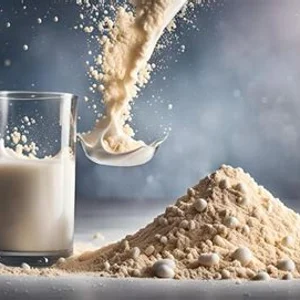
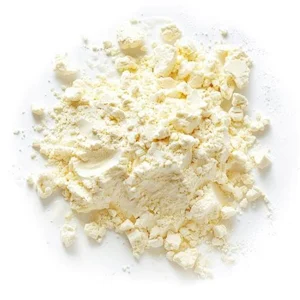
The SPD series turns liquid feed into free-flowing powder in a single step. Feed liquid is atomized into a hot-air stream — droplets flash-dry in seconds and fall as powder while moisture leaves with the exhaust air. One continuous operation replaces the evaporation-then-drying-then-milling chain, and because droplet temperatures stay near wet-bulb during the critical drying fraction, heat-sensitive solids survive a 160–220°C inlet air stream.
What this machine makes: milk powder and infant-formula base, juice and vegetable powders, whole-egg and egg-white powder, maltodextrin-carried flavor powders, coffee extract, protein isolates, soy and plant extracts, and soup/beverage premix bases. If your product is a liquid with a powder SKU, this is the machine category. In the dairy chain it sits downstream of the UHT sterilizer and homogenizer, and discharges to the PWF powder filler.
1. Atomization. High-pressure nozzles (finer control, cheaper wear parts) or rotary discs (handles slurries and high throughput, less clog-sensitive). We spec rotary disc above ~100 kg/h evaporation or on feeds with particles; nozzles below that and on fine-powder SKUs.
2. Air flow. Co-current (air and feed travel the same way — gentlest on heat-sensitive solids, the food default) or mixed-flow (taller chambers, more thermal duty per m³). Food powders are co-current in most plants.
3. Open vs closed cycle. Open cycle exhausts to atmosphere — standard for water-based feeds. Closed cycle with nitrogen recovery is for solvent-based feeds (some extracts and flavors); it is a different plant, quoted separately.
4. Two-stage with integrated fluid bed. Single-stage dryers push powder straight to baghouse. Two-stage designs add a vibrating fluid bed at the cone for finish drying and agglomeration — the difference between dusty powder and instantized powder that wets and disperses in cold water. Retail instant products are two-stage.
| Parameter | SPD-101 pilot | SPD-001 standard | SPD-201 industrial |
|---|---|---|---|
| Water evaporation | 5–15 kg/h | 30–80 kg/h | 100–250 kg/h |
| Inlet air temperature | 140–220°C | 140–220°C | 140–220°C |
| Outlet air temperature | 75–95°C | 75–95°C | 75–95°C |
| Feed types | liquids, fine slurries | liquids, slurries | liquids, heavy slurries |
| Atomizer | pressure nozzle | nozzle or rotary disc | rotary disc |
| Powder recovery | cyclone + baghouse | cyclone + baghouse | cyclone(s) + baghouse |
| Installed power | 30–50 kW | 80–150 kW | 200–400 kW |
| Main chamber height | 4–7 m | 8–14 m | 16–24 m |
| Instantizing fluid bed | optional | optional | standard option |
Pilot chambers exist for recipe work — droplet size, inlet curve, and carrier ratio proven at 5 kg/h scale up to production chambers on the same physics. *(typical range, configurable per feed)*
| Utility | SPD-001 standard (indicative) |
|---|---|
| Steam or hot air generator | 300–600 kW thermal |
| Electricity | 80–150 kW |
| Cooling water | 5–15 m³/h |
| Compressed air | 1–2 m³/min |
| Installation height | 10–16 m (chamber + baghouse) |
| Floor area | 80–150 m² including auxiliaries |
Spray dryers are plant-defining equipment: they arrive as chamber sections on flatbeds and want 10 m+ of internal height. Layout support with a GA drawing is part of our quotation. Feed-side preparation — pre-grinding, mixing, pre-heating — pairs with our colloid mills; the wider liquid-processing chain is on the dairy processing hub, including the milk pasteurizer and yogurt fermentation tanks.
Yes — send 20–50 kg of feed. We run it on a pilot chamber and return powder samples, the inlet/outlet curve, carrier recommendation if needed, and a scale-up duty calculation. This is the standard first step for every new product.
Pure fruit solids are thermoplastic — they soften at drying temperatures and smear on the chamber wall. Carriers raise the glass-transition temperature so powder forms and stays free-flowing. Typical carrier loads are 20–40%; low-carrier powders are achievable with specialized chamber designs at higher cost.
Mesh 60–120 typical for single-stage; agglomerated instant powders are coarser (mesh 20–60) with better wettability. Exit moisture 3–5% (product-dependent) with fluid-bed finish to <2% where the SKU requires.
Wet CIP with spray balls on a rotate-through circuit — chambers are built with CIP headers as standard, not as an option. Dry cleaning between water-wettable products; full wet CIP between allergen groups.
Thermal energy dominates (raising inlet air to 160–220°C), then fan power. Gas-fired direct air heaters run cheaper per kWh than electric in most markets; both are configurable.
60–120 days build depending on tier; installation and commissioning 10–20 days with our engineers, including first-product runs and operator training. Annual contracts for revisits are available.
The falling-film evaporator that pre-concentrates feed is quoted with the dryer as a system — running the dryer on dilute feed multiplies energy cost per kilogram of powder. We size the pair together.
Nozzle inserts/discs, gaskets, filter bags, and pump consumables. A 12-month kit ships with the machine; high-wear nozzle sets are quoted per your feed abrasiveness.

 7 * 24 Support
 Remote Support
 Global Coverage